
The complete guide
Silk Scrunchies Buyer's Guide: Choosing Skinny Silk Hair Ties That Hold
The small annoyance nobody mentions
Hair ties are one of those things you only think about when they go wrong. A rubber band snaps and takes a few strands with it. A cheap elastic leaves a sharp dent across the back of your ponytail. A wide fabric scrunchie looks lovely in the morning and sags by lunchtime. None of this ruins a day, but it is a steady, low-level irritation, and most people put up with it for years because hair ties are cheap enough not to bother replacing properly.
The fix is not complicated. The two things that matter are what the surface of the tie is made of, and how wide the band is. Get both right for your hair and the tie stops being something you notice.
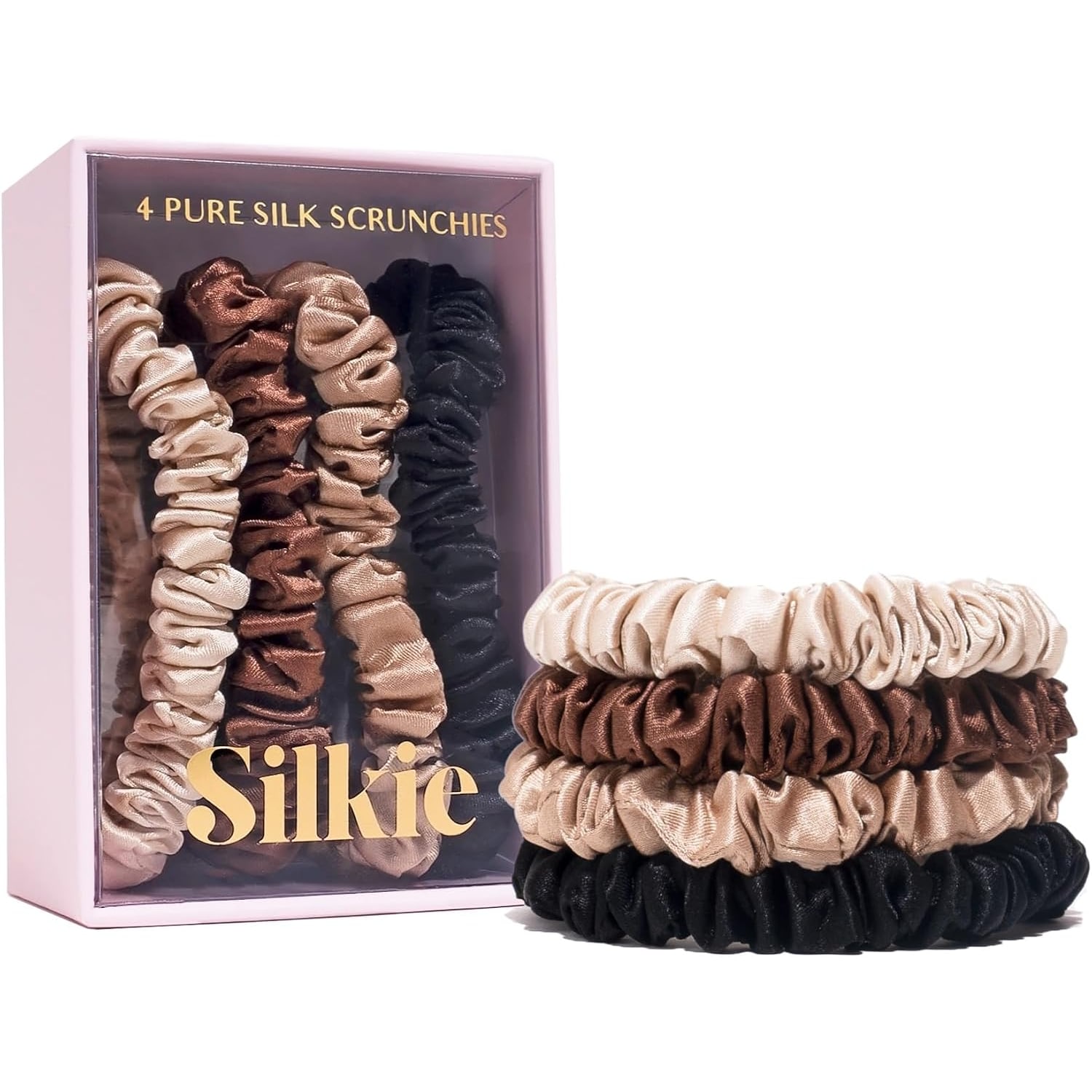
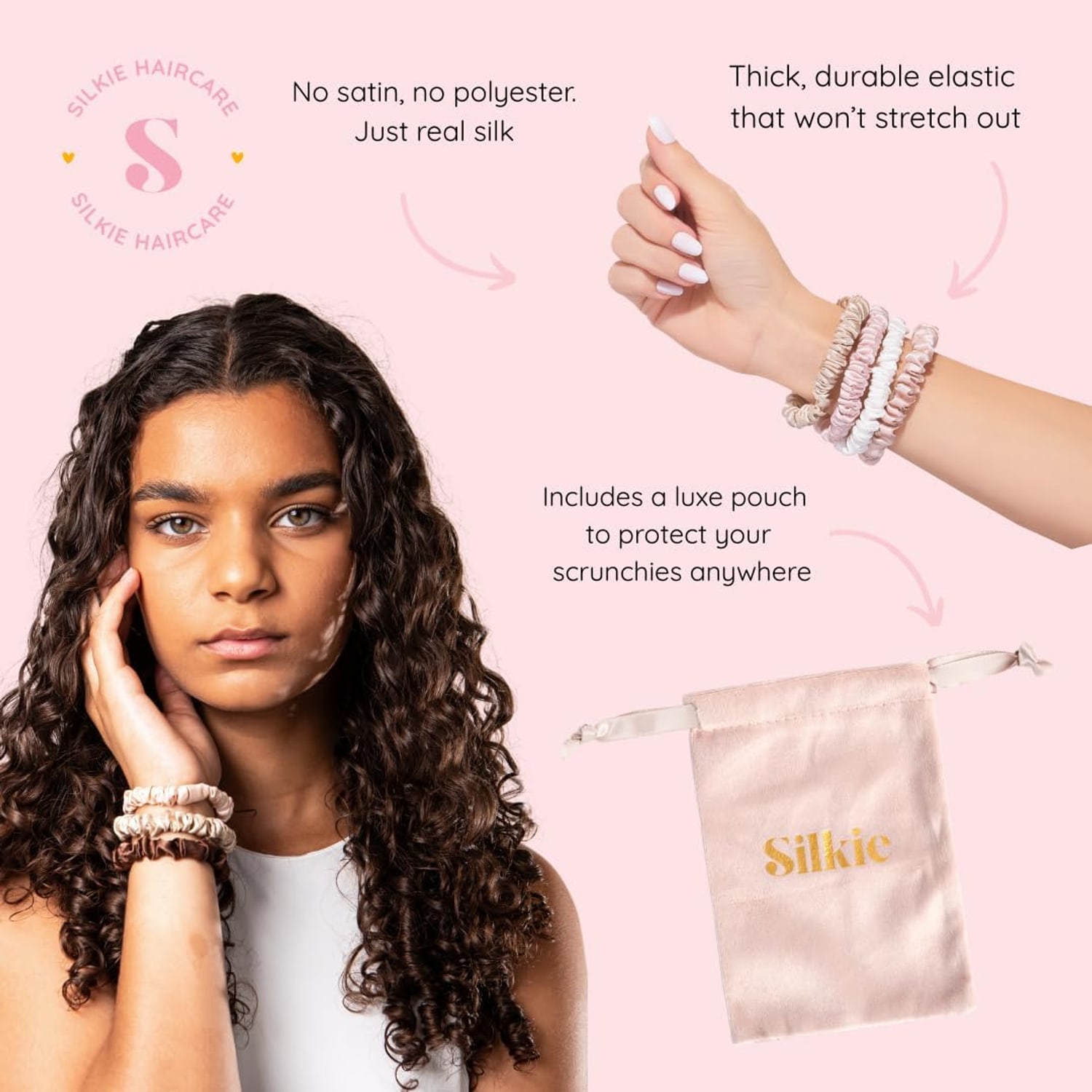
This set deals with both. Each of the four scrunchies is wrapped in 100% mulberry silk over an elastic core, and all four are skinny bands rather than wide ruffles. The shades are beige, brown, taupe and black, and they come with a small travel pouch.
What the silk actually does
Silk is smooth. That sounds obvious, but it is the whole point. When you pull a tie out of your hair, the strands have to slide across the surface of the band. A rubber band has a tacky, grabby surface. A cotton scrunchie has thousands of short fibre ends standing up from the weave, and every one of them has a little grip on the hair. Silk has long, fine fibres lying flat, so there is far less to catch on.
You feel it most at the end of the day, when the tie has been in for eight or nine hours and the hair has settled around it. With a plain elastic that is the moment of the tug. With silk the band tends to come away more easily.
The elastic inside is still doing the holding. Silk on its own would not keep a ponytail up. So you get grip from the core and a smooth surface from the cover, which is a sensible division of labour.
Mulberry silk, specifically, comes from silkworms fed on mulberry leaves. The fibres are long and even, which is why it is the silk type used for pillowcases, sleep masks and hair accessories. The momme weight of the fabric used here is not stated, so we will not guess at it.
Why skinny, and when wide is better
Band width is mostly a style decision, with a bit of practicality attached.
A wide scrunchie makes a visible gathered ruffle at the base of the ponytail. Some people want exactly that. It is a look, and a wide band also spreads pressure over a larger area, which some find comfortable on very thick hair.
A skinny band does the opposite. It sits close to the hair and mostly disappears. That makes it the better pick for a sleek high ponytail, a low chignon, the end of a plait, or any time you do not want the tie to be part of the outfit. It also fits where a wide band will not: under a cycling helmet, under a cap, under the arm of a headset, inside a hood.
If you are deciding between the two, think about where the tie will actually sit. Hair tied high and on display tends to suit skinny. Hair tied low and casual can carry either.
Who this set suits
Four neutral shades is a specific choice and it suits some people far better than others.
If you wear a lot of black, grey, navy and tan, this set works with almost everything you own. If you want bright colours or prints as part of a look, it will feel plain and you would be happier with a patterned set.
By hair colour, black is the obvious match for dark hair but also the safest with any outfit. Brown and taupe sink into mid and light brown hair. Beige is the most discreet on blonde and fair hair, close to invisible from a few steps away.
By hair type, the skinny band suits fine to medium hair very comfortably. Thick hair works too, just with fewer wraps. People hunting for the best skinny silk hair ties usually land here because they want hold without the tie becoming an accessory.
Getting the hold right
A silk surface is smooth, which is the benefit and also the thing to manage. A smooth tie can slip on very slippery hair if you under-wrap it.
Start with two wraps. If the ponytail drifts down over an hour, add a third. What you should not do is stretch the band hard to force an extra turn, because over-stretching is what kills elastic. If three wraps feels like a fight, two firm ones in a slightly lower position will usually hold better anyway.
Day-old hair holds better than freshly washed hair, which is true of every hair tie ever made. A light texture spray helps if you need a high ponytail to stay put on clean hair.
Caring for silk over elastic
This is a fabric band with a stretch core inside, so treat it like a delicate.
Hand wash in cool water with a small amount of detergent made for delicates. Swirl rather than scrub, rinse until the water runs clear, then press the water out in a towel. Do not wring or twist it hard, because that stresses both the silk and the elastic underneath.
Dry flat, away from radiators and strong sun. Heat is hard on elastic and sunlight fades dye. Do not tumble dry.
Wash the darker shades apart from the beige the first time, which is standard sense with any dyed fabric.
If a machine wash is unavoidable, use a mesh bag, a cool delicate cycle and no spin. It will work, but repeated machine washing will shorten the life of the set.
How often? Every couple of weeks for ordinary wear, more if you wear them at the gym or with styling product in your hair. Oils build up and dull the silk surface over time.
Skipping the ironing is wise. There is elastic in there. If a band comes out creased, smooth it with your fingers while it is damp and leave it to dry flat.
The pouch is not just packaging
Four slim bands are very easy to lose. They slide to the bottom of a handbag and come back out wrapped around a biro.
The bigger issue is snagging. Silk is strong along the fibre but it will pull if it catches on something sharp, and a handbag is full of zips, keys and nail files. Keeping the set in its pouch between uses is the single easiest thing you can do to make them last. Same goes for travel, where the pouch means the set arrives together rather than scattered through a suitcase.
Making a set of four last
Rotate them. If you always grab the black one, the black one wears out in a quarter of the time and you are left with three near-new ties you never chose.
Take them off your wrist at the end of the day rather than leaving them stretched overnight. Elastic held under tension for long stretches recovers less well.
And keep an eye on the stitched seam where the band is joined. That is the point that takes the strain, and it is the first place a tired tie shows its age.
The short version
This is a four pack of skinny scrunchies, each one 100% mulberry silk over an elastic core, in beige, brown, taupe and black, with a travel pouch.
Pick it if you want a discreet tie that slides out of your hair easily, you prefer neutrals to prints, and you like having a shade for every outfit without thinking about it. Pick a wide scrunchie instead if you want the tie to be visible as part of the look, or a cotton one if you want maximum surface grip.
Wash them by hand, dry them flat, keep them in the pouch and rotate all four. Do that and a set like this stays useful for a long time.