
The complete guide
The Honest Buyer's Guide to 22 Momme Silk Bonnets
The problem with waking up to hair you have to fix
Most of us accept a certain amount of morning repair work. Hair that looked fine at bedtime turns up flattened on one side, roughed up at the ends, or pulled into a shape that takes ten minutes and a lot of water to undo. Curls lose definition. Blow-dries lose their smoothness. Braids fray.
A lot of that happens for a boring mechanical reason. You move in your sleep, probably more than you think, and every turn drags your hair across the pillow surface. Cotton is a relatively grippy fabric. Hair catches on it, gets pulled, and ends up disturbed.
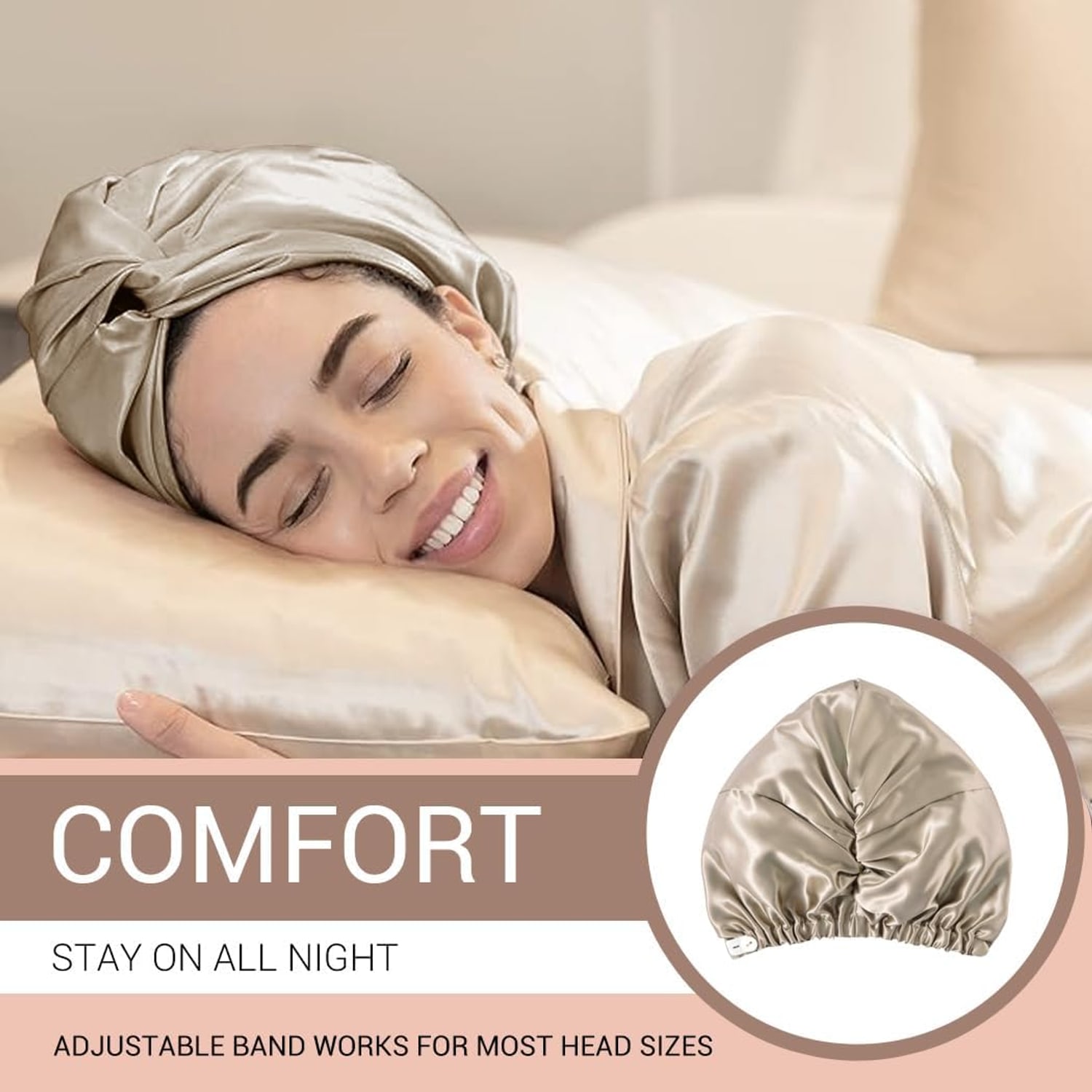
A silk bonnet solves the problem from the other direction. Instead of changing the pillow, it wraps your hair in a smooth fabric and keeps it contained. Whatever your pillowcase is made of, your hair spends the night against silk.
What 22 momme actually tells you
Silk is sold by momme, written as mm, which measures fabric weight. The number comes from an old Japanese unit and it works in a simple way. The higher the momme, the more silk is packed into the same area of fabric.
Bonnets on the market sit roughly between 16 and 25 momme. Sixteen is light and a bit floaty. Nineteen is the common middle ground. Twenty-two, like this cap, is on the heavier side for a hair accessory. You notice the difference as soon as you handle it, because the fabric has drape and weight instead of feeling like a scarf offcut.
Weight matters for a bonnet in a way it does not for, say, a silk ribbon. A heavier cap tends to settle onto the head and stay there. A very light one is more likely to ride up as you shift position. That is the practical argument for paying attention to momme rather than treating it as marketing shorthand.
Why double layer is worth checking
Here is something that catches a lot of buyers out. Plenty of caps described as silk bonnets are actually silk on the inside only, with a polyester or satin-finish outer. The description is technically honest, but the piece is not all silk.
This one uses two layers of silk, so both surfaces are the same material. That changes a couple of things. The cap holds its shape a bit better than a single-layer version, which helps it sit evenly across the head. And because there is no synthetic outer, the whole thing washes and dries as one material with one set of care rules.
The trade-off is that a double layer silk cap costs more than a lined one. You are paying for twice the silk. Whether that is worth it depends on how much you care about the construction and how long you expect to keep the cap.
Who this cap suits, and who it does not
The maker is specific here, which is helpful. It is listed as suitable for short through to long hair, including curls and waves. It is not recommended for very thick or voluminous hair.
That is worth taking at face value. A bonnet works by containing hair comfortably, not by squeezing it. If you have a lot of hair, an overfilled cap will bulge, sit unevenly, and work its way off during the night. You would be better served by an oversized or extra-deep cap.
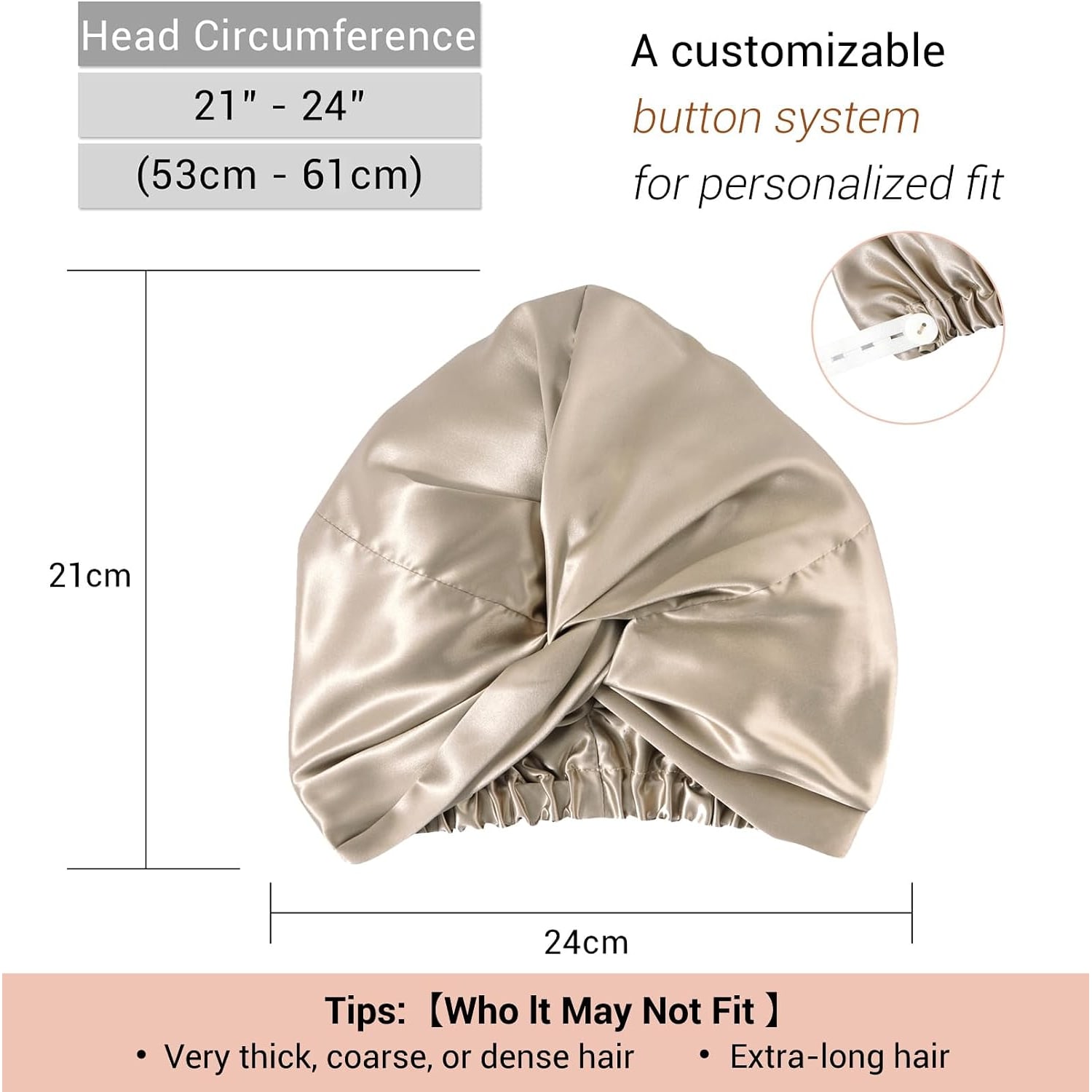
If you are between the two, do a quick check. Gather your hair the way you would before bed and see how much bulk you are dealing with. The cap measures about 26 x 24 cm, roughly 10 x 9.5 in, laid flat. Hold a tape measure against your gathered hair and compare. It is a rough test but it catches most of the obvious mismatches.
The best silk bonnet for one person is not automatically right for the next. Hair volume is the variable that decides it.
Getting the fit right
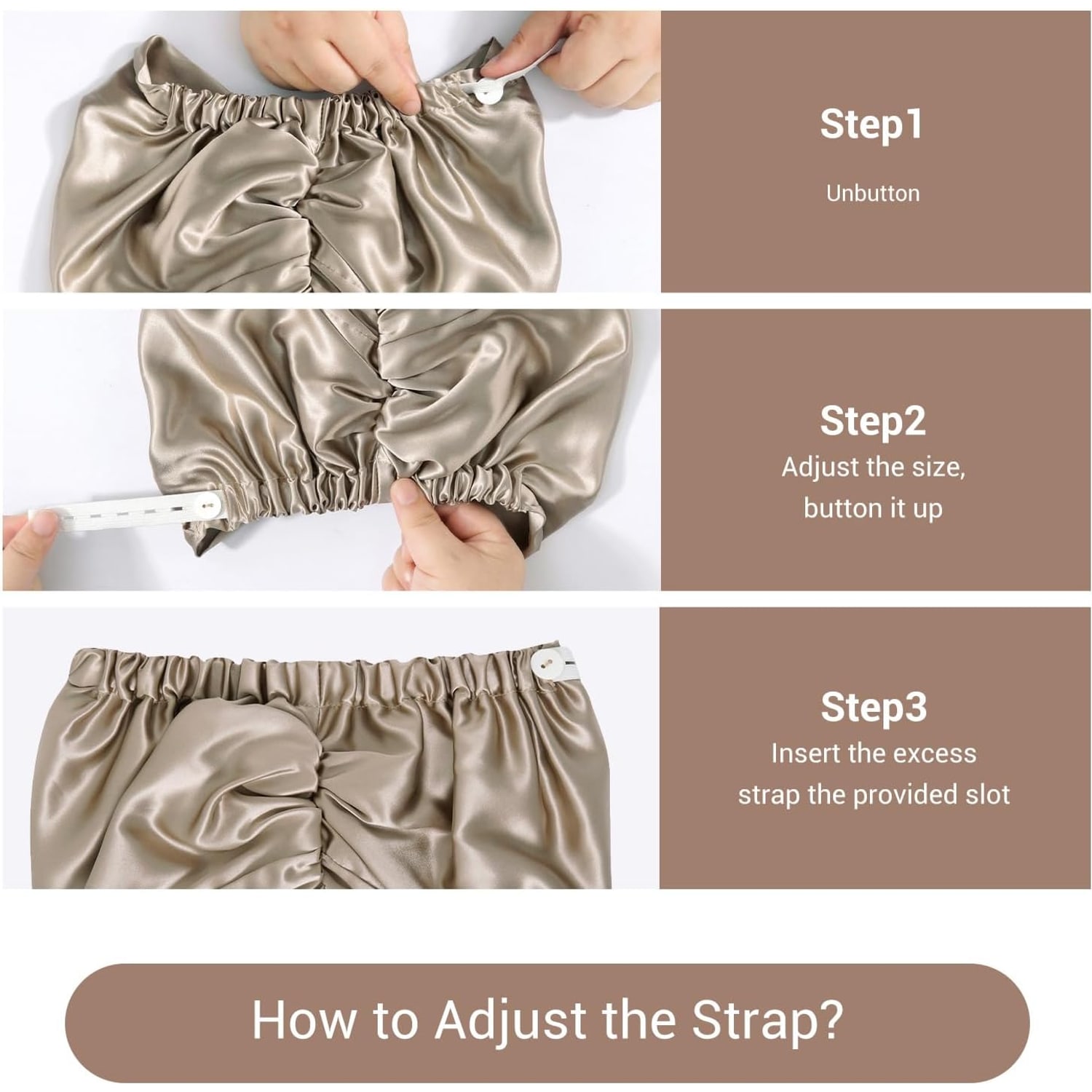
The cap is one size with an adjustable closure, which means you do the sizing yourself. It takes a couple of nights to find your setting.
Start looser than you think. Put the cap on, tuck in any stray lengths at the nape and around the ears, then draw the adjustment in until the cap feels secure when you shake your head gently. Stop there. If you wake with a line across your forehead, you went a notch too far.
Tuck evenly rather than bundling everything to one side. A lumpy cap creates pressure points and those pressure points are where it starts to slide. Spreading the hair out gives you a flatter, more stable fit.
If the cap still comes off, the usual culprits are too much hair inside, or an adjustment that was set while your hair was damp and then loosened as it dried.
The scrunchie is more useful than it looks
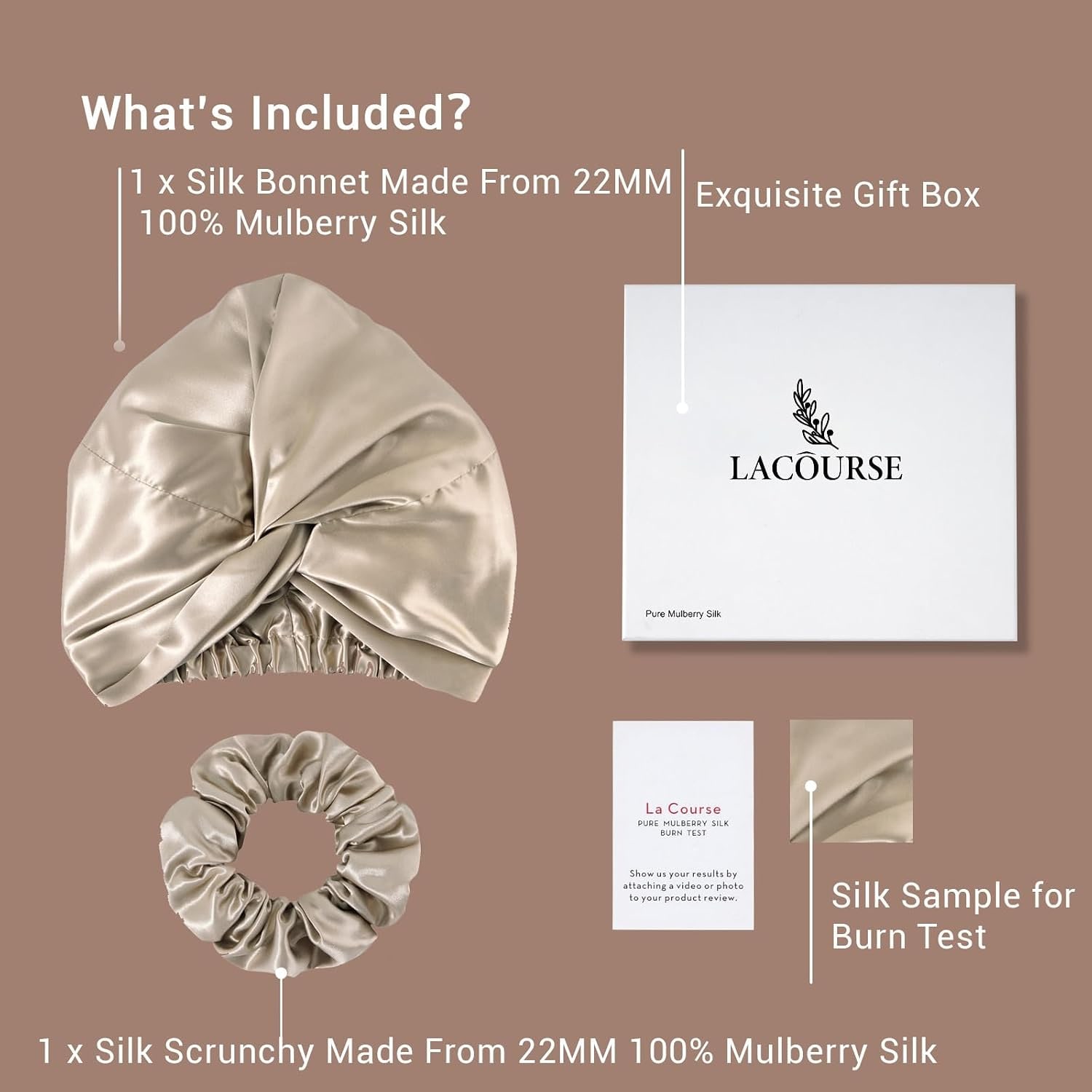
An included accessory can feel like filler, but a silk scrunchie earns its place. Tying hair back in silk before the cap goes on keeps everything in the same smooth fabric, and it avoids the dent a tight elastic leaves.
It is also the half of the set you can use in daylight. A matching caramel scrunchie goes with most things and is a genuinely nice object in its own right. Some people buy a silk bonnet set mainly for the cap and end up reaching for the scrunchie more often.
Both pieces take the same washing routine, which keeps life simple.
Looking after silk without overthinking it
Silk has a reputation for being fussy. It is really not, as long as you avoid two things, heat and harsh detergent.
Wash in cool water, either by hand or on a cold delicates or silk machine cycle with the cap inside a mesh bag. Use a mild detergent intended for delicates. Skip bleach and skip fabric softener, which coats the fibres and dulls the surface.
Do not wring it out. Lay the cap flat on a clean towel, roll the towel up and press gently, then unroll and dry the cap flat or hanging somewhere with air moving. Keep it out of direct sunlight and away from radiators. If it needs a press afterwards, use the coolest iron setting on the reverse side with a cloth in between.
Wash every week or two under normal use, more often if you sleep in oils or heavy leave-in products. If you want a cap always ready to go, a spare is the simplest answer, because silk air-dries slowly.
How it fits into a wider silk routine
A bonnet pairs naturally with a silk pillowcase, though it is not a requirement. The cap handles your hair. A pillowcase handles everything that touches your face. Some people use both, some use one.
If you are starting with just one item, the cap tends to give the more noticeable result for hair, because it keeps the hair contained rather than just giving it a smoother surface to move on. A pillowcase is the better first buy if your main concern is how your face rests overnight.
The short version
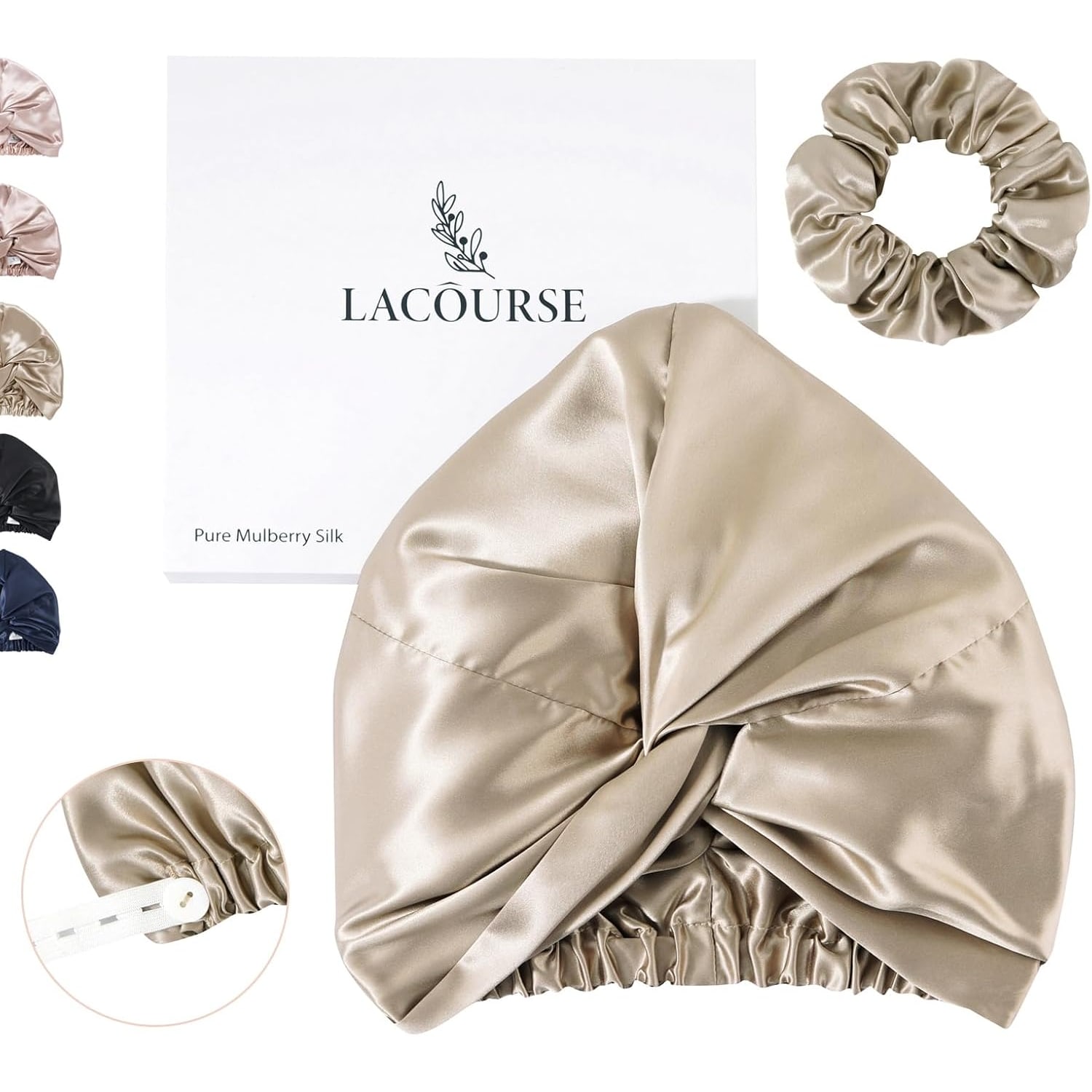
This is a caramel sleep cap in 100% mulberry silk, built in two layers at 22 momme, measuring roughly 26 x 24 cm flat, with an adjustable closure and a matching silk scrunchie in the box.
It suits short to long hair, curls and waves. It is not the right cap for very thick or voluminous hair, and the maker says so plainly, which is worth respecting.
Set the fit snug and not tight. Wash cool, dry flat, keep it away from heat. Do that and you have a simple piece of bedtime kit that does one job well.