
The complete guide
How to Choose and Wear a Long Silk Scarf
The problem with most scarves
Most people own a scarf they never wear. It is usually one of two things. Either it is a big wool number that only makes sense in January, or it is a small square that needs folding into a shape before it looks like anything. Both end up at the back of the drawer.
A long silk rectangle sidesteps both problems. It is light enough to wear in spring and autumn, it works indoors without making you too warm, and it needs no folding ritual. You pick it up, put it round your neck, and it already looks intentional.
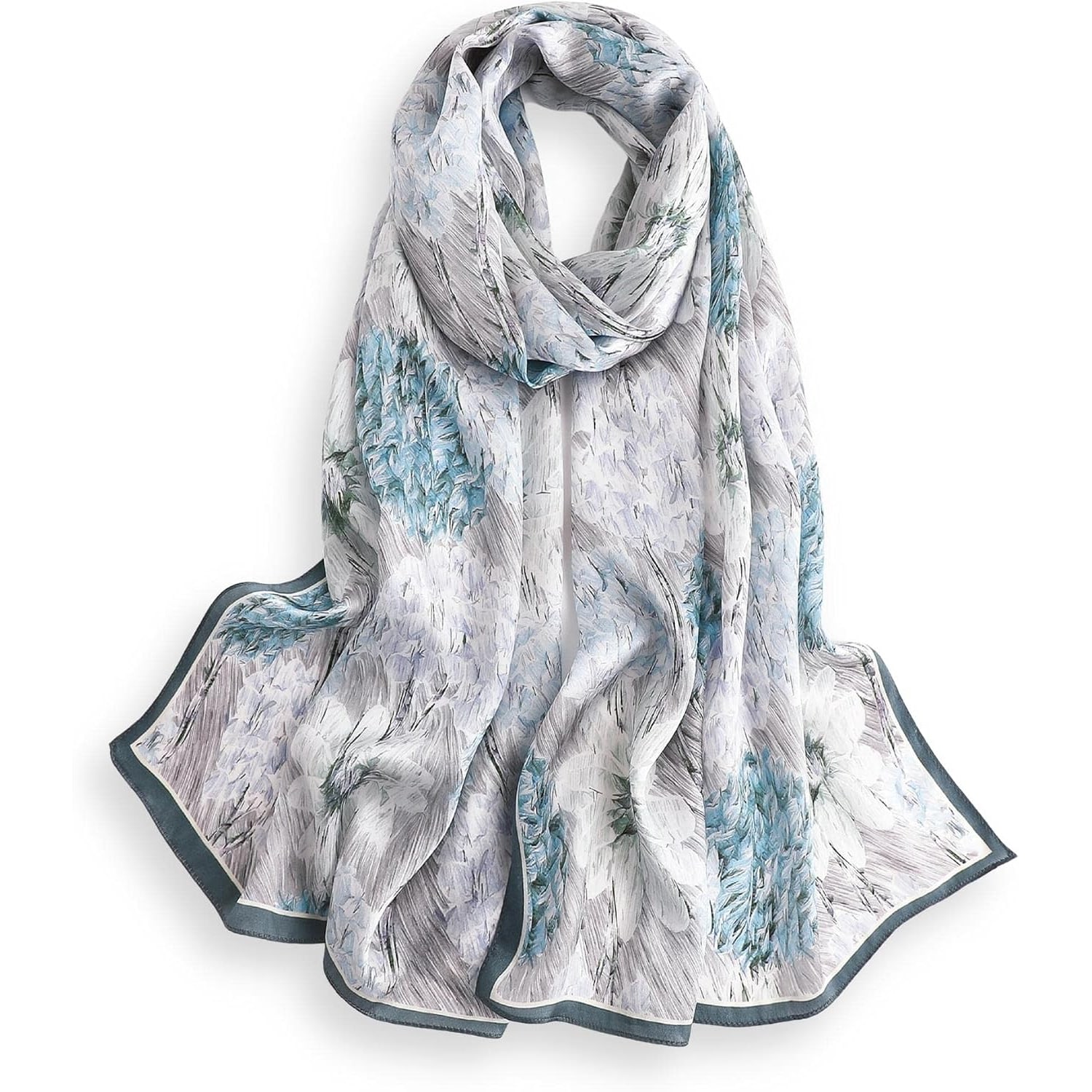
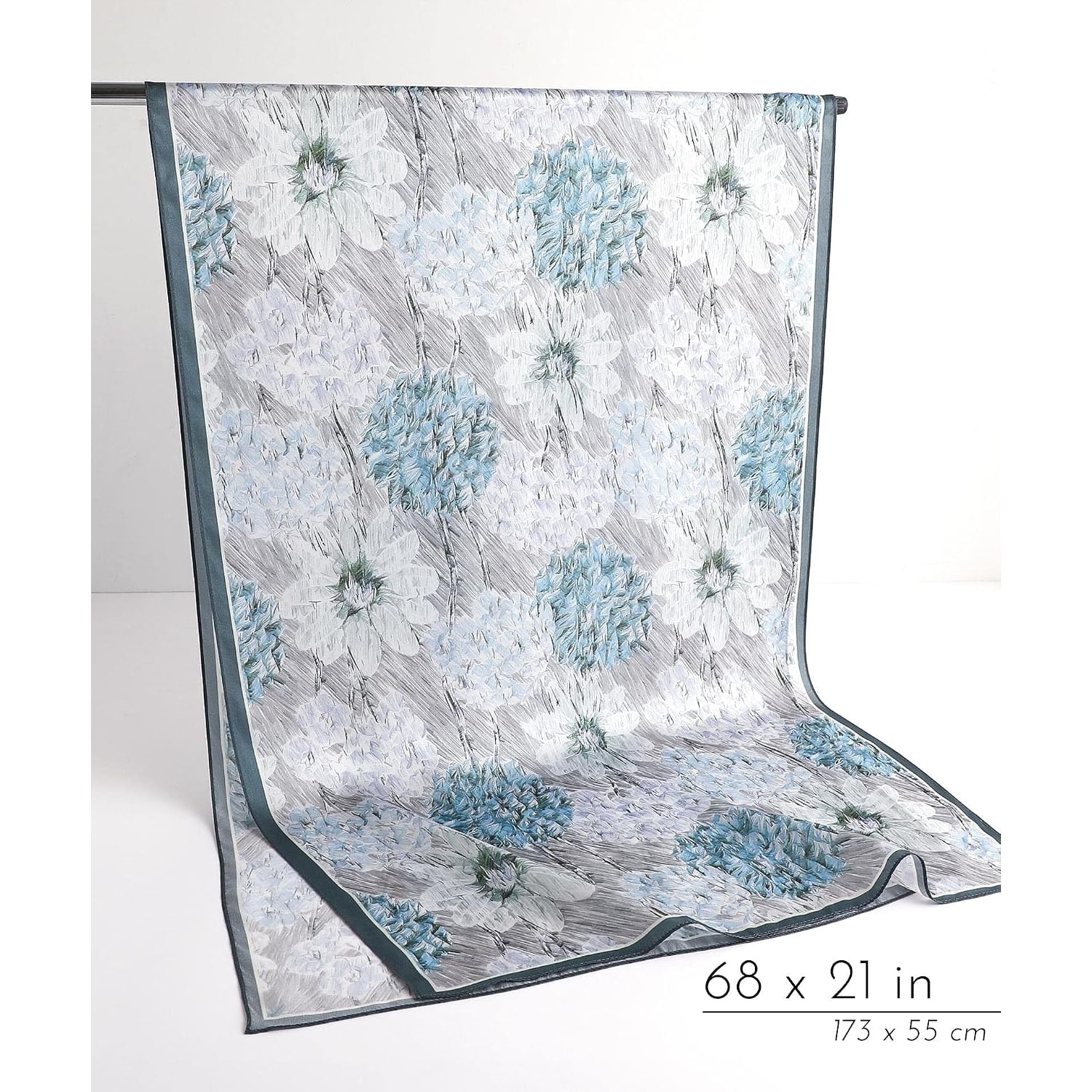
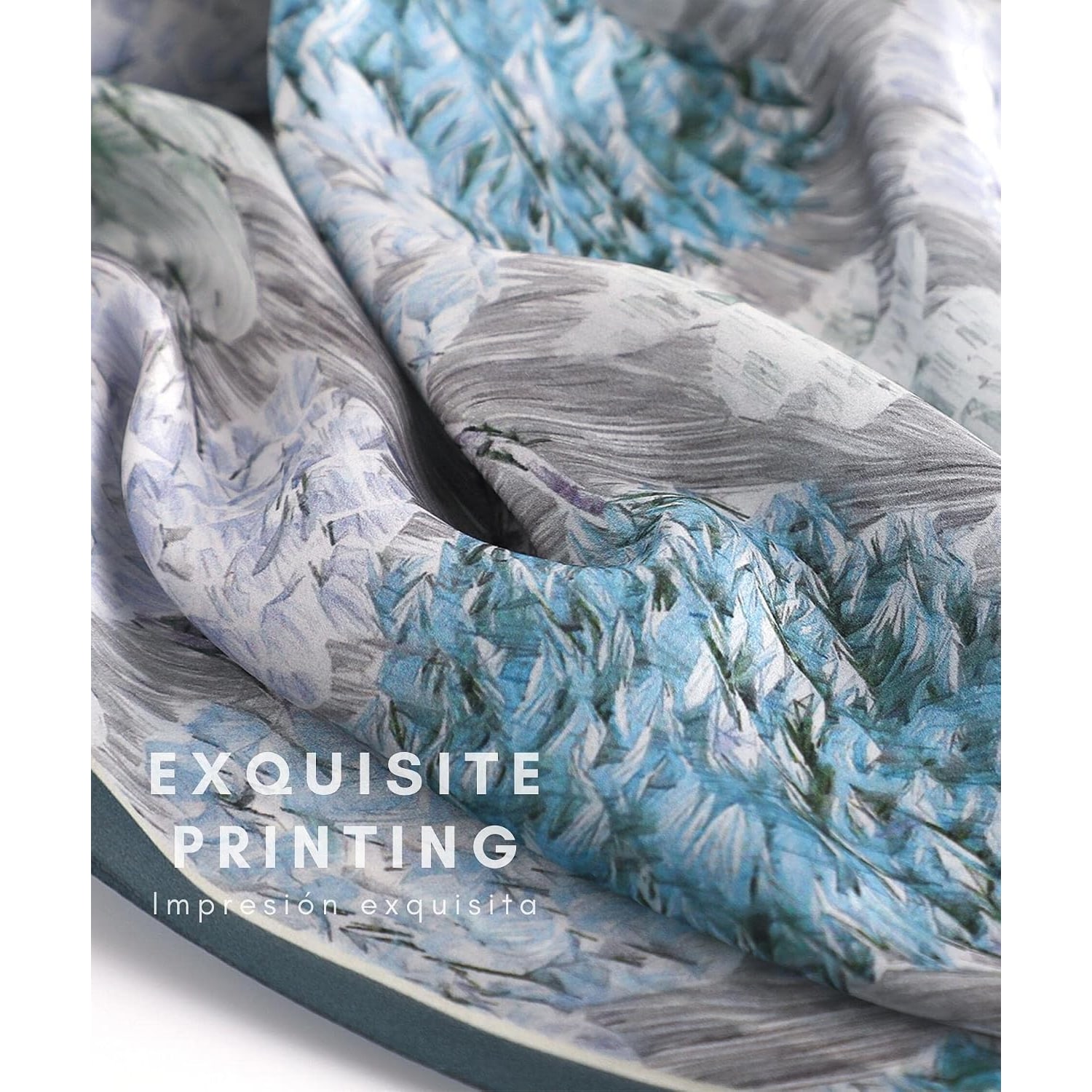
That is the case for this one. It is 100% mulberry silk, cut at 173 x 53 cm (68 x 21 inches), with a hydrangea blossom print in soft grey and blue.
Why the length matters
Scarf length changes everything about how a scarf behaves, and 173 cm is a useful number.
Shorter scarves, around 130 to 150 cm, are really only neck scarves. You can loop them once and that is it. Anything you try beyond that runs out of fabric.
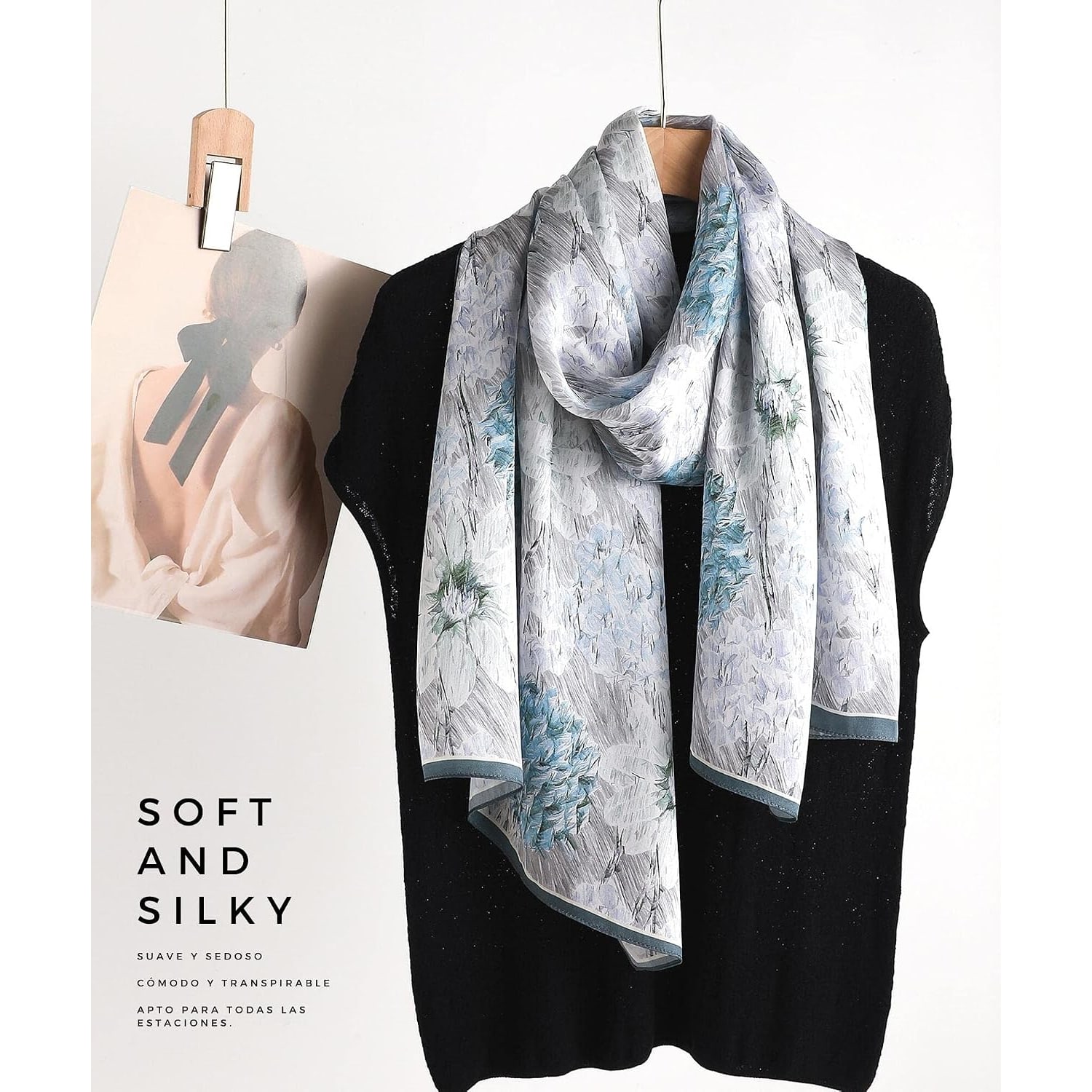
At 173 cm you have slack to play with. Looped twice, the ends sit at chest height and the scarf reads as neat and deliberate, which is what you want under a jacket collar. Left to hang, it runs down past the waist on most people and draws a long vertical line, which is flattering and adds colour to an otherwise plain coat.
Fold it in half lengthwise and the 53 cm width becomes a 26 cm band. That is the version you tie over the hair, knot at the side of the neck, or thread through belt loops if you want something less expected.
And because it is 53 cm across rather than the 20 cm of a skinny scarf, you can open it out across the shoulders. It is a light cover, not a stole, but on a cold train or in an over-air-conditioned restaurant it does the job.
What mulberry silk actually brings
Silk gets talked about in vague terms, so here is the practical part.
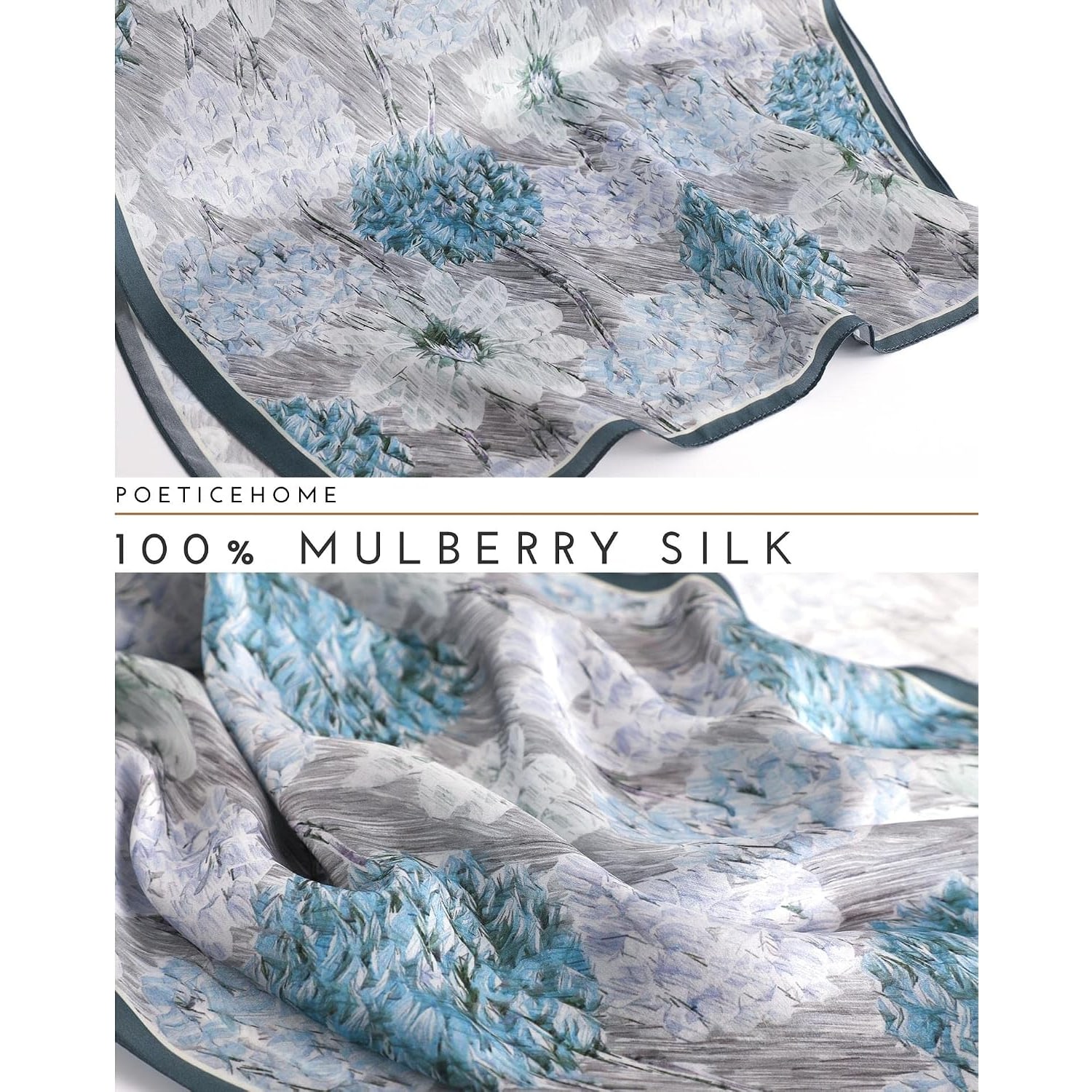
Mulberry silk comes from silkworms fed only on mulberry leaves. That diet produces long, even filaments, and long filaments make a smooth, strong yarn. The fabric that results has a fine surface with very little texture to it.
In wear, that means three things. The scarf slides instead of grabbing, so hair and skin move over it with less friction than cotton. It drapes rather than holds a shape, so it falls into soft folds instead of standing away from the body. And it is light, which is why a scarf this big can be folded into a pocket.
That lightness is also the reason silk layers so well. A wool scarf under a coat collar creates bulk and pushes the collar out of line. Silk sits flat. You can wear it all day inside without noticing it is there.
Reading the print
The pattern here is hydrangea blossom in grey and blue. It is worth thinking about what that means in practice, because print scale and colour do more work than people expect.
Hydrangea heads are made of many small florets, so the print has fine detail rather than big bold blocks. From a few steps away it reads as a soft blur of colour. Up close you see the structure. This is a useful property in a scarf, because the bits that are visible when it is looped and knotted are small, and a large-scale print often looks chopped up when it is worn.
Grey and blue is also one of the easier colour pairings to dress around. It works with navy, denim, charcoal, black, white, cream and grey. It sits nicely next to blush and soft pink if you want something warmer. It will fight a bit with bright orange or strong red, so if your wardrobe runs warm you would want to try it against your coat before committing.
If you are hunting for the best floral silk scarf to wear with a wardrobe built on neutrals, a muted grey and blue print is an easier buy than a bright one.
Who it suits
This scarf makes most sense for someone who wants one accessory that covers a lot of ground. It goes over a work outfit, over a casual jumper and jeans, and over something smarter in the evening. It is not a statement piece that only comes out twice a year.
It also suits people who travel. A long silk scarf takes up almost no space, works on the plane and at the destination, and does not crease badly enough to be a problem. Anyone looking for the best silk scarf for travel ends up at roughly this specification.
It suits people who find wool itchy around the neck. Silk is smooth and has none of that prickle.
It is less suited to anyone who wants real warmth. If you need a scarf for a cold winter commute, you want wool or cashmere, and a silk scarf like this becomes the thing you wear over the other nine months.
How to choose between a square and a long rectangle
If you are weighing this against a square scarf, the honest difference is effort.
Squares are versatile but they ask something of you. You fold them into a bias strip, or a triangle, or you learn a few knots. Done well they look wonderful. Done in a rush they look like a napkin.
Long rectangles are forgiving. There is almost no wrong way to wear one. If you want a scarf you will actually reach for on a weekday morning, the rectangle usually wins. If you enjoy the fiddling and the different arrangements, a square has more range.
Width matters too. A narrow 20 cm silk band is a decorative accent and nothing more. At 53 cm you get the accent plus the practical cover. That is a good middle point.
Caring for it
Hand wash only. This is not a suggestion with silk, it is the thing that decides how long the scarf lasts.
Use cool water and a detergent made for delicates. Fill a basin, swirl the scarf through, give it a couple of minutes, then rinse until the water runs clear. Do not scrub, do not wring and do not twist. Wringing is what breaks the fibres and leaves a permanent ripple in the fabric.
To dry, lay the scarf flat on a dry towel, roll the towel up to press out the water, then unroll and leave the scarf flat on a fresh dry surface. Keep it out of direct sun, which fades printed colour faster than anything else, and away from radiators.
If it needs pressing, use a low iron while the scarf is still slightly damp and put a cloth between the iron and the silk. Pressing on the reverse side is safer still.
For storage, roll rather than fold if you have room. Tight creases left in place for months can set. A drawer or a fabric pouch is fine. Avoid plastic, which traps moisture.
Spills want immediate attention. Blot, do not rub, then rinse the spot in cool water as soon as you reasonably can.
A few ways to wear it
Loop it twice and leave the ends loose for the everyday version. Drape it long and open down the front of a coat when you want the colour to show. Tie a loose knot off to one side for something slightly more considered. Fold it lengthwise and tie it over the hair for warm weather or a bad hair day. Open it across the shoulders when a room is cold.
None of these need practice. That is the point.
The short version
This is a 100% mulberry silk scarf, 173 x 53 cm (68 x 21 inches), with a hydrangea print in soft grey and blue. The length gives you several ways to wear it, the width makes it useful as a light cover as well as a neck scarf, and the muted colours mean it goes with most of what you already own.
It is light, it packs down to nothing, and it needs hand washing. If you want one scarf that earns its place from spring through autumn and travels well, this is the shape and the fibre to look at.