
The complete guide
Choosing a Contoured Silk Sleep Mask, A Practical Buyer's Guide
The problem with most sleep masks
You buy a sleep mask because something is waking you. A streetlight through thin curtains. A partner who reads at midnight. A night shift that forces you to sleep at ten in the morning while the world outside carries on. The mask is meant to fix that, and often it half does.
The trouble is the shape. A standard mask is a flat rectangle of padded fabric held on by elastic. Lay it over your face and the fabric rests directly on your eyelids. You can feel it. If you open your eyes under it, your lashes brush the lining. If you wear any eye make-up, it transfers. And because flat fabric cannot follow the slope of a nose, there is almost always a little triangle of light sneaking in on either side of the bridge.
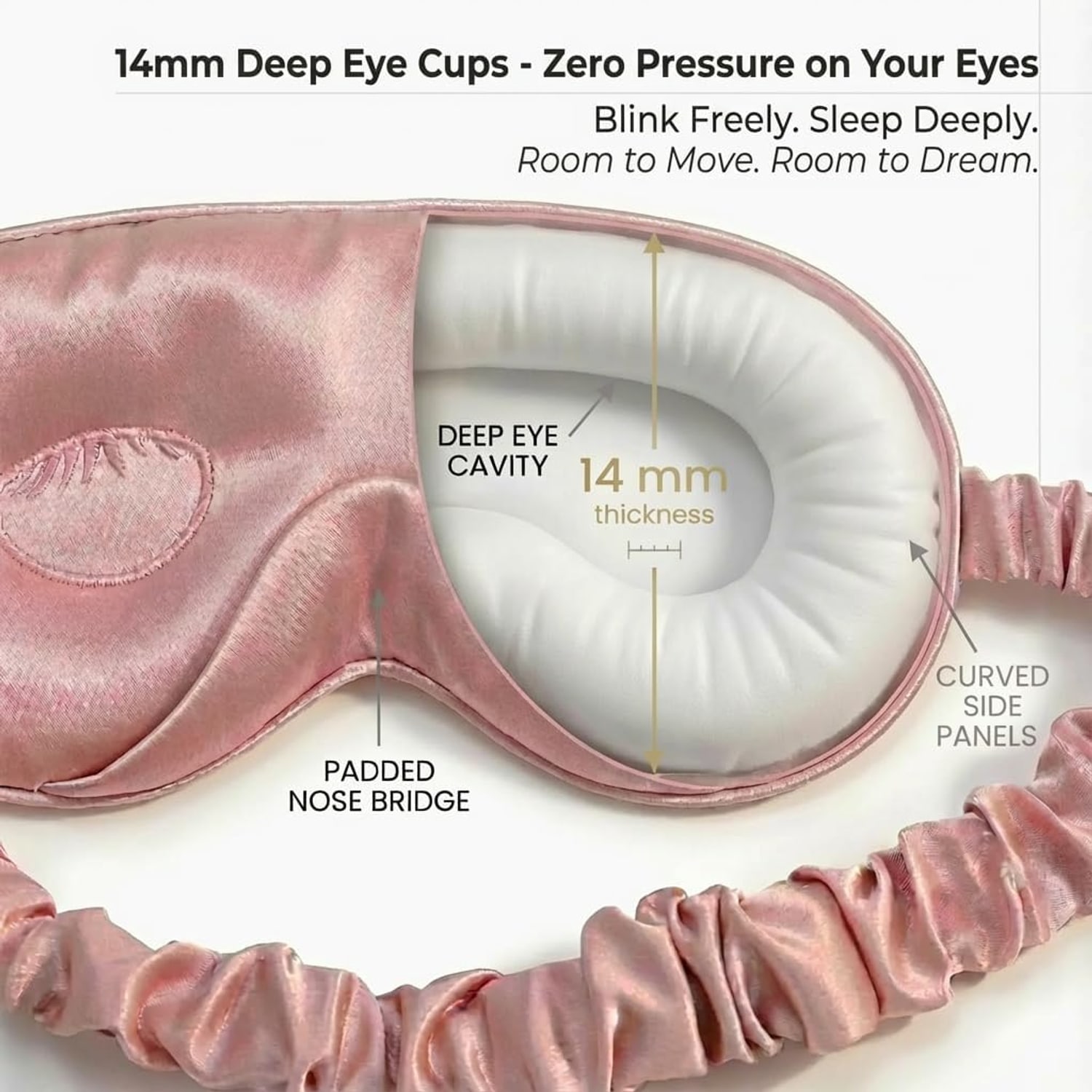
A contoured mask solves that with geometry rather than more padding. The front is moulded into two cups, each about 14 mm deep on this one. Your eyes sit inside an air pocket. Nothing touches them. Meanwhile the nose bridge is shaped to meet your face and the sides curve down along the cheekbones, so the edges stay in contact where it matters.
What 22 momme actually tells you
Silk is measured in momme, not thread count. It is a weight measure, roughly how heavy a set length of fabric is. Light scarf silks sit in the single digits and low teens. Bedding silks generally start around 19 momme and go up from there. At 22 momme, this sits comfortably in the range people mean when they say proper silk.
Why does that matter for a mask? Three practical reasons. Heavier silk has more body, so it holds a moulded shape instead of collapsing after a few washes. It is more opaque, which helps with light. And it wears better, because there is simply more fibre there to take the rubbing of a strap and a pillowcase night after night.
The silk is also described as grade 6A. That refers to the quality of the raw filament, essentially how long and even the fibres are. Longer, more consistent fibres make a smoother surface with fewer slubs. It is the kind of detail that you feel rather than see.
What silk does not do is magic. It is smooth, it is cool to the touch, and things slide over it with less friction than they do over cotton. That is the honest description. Anyone promising more than that is selling you a story.
Who this suits
Side sleepers do well with it, mainly because there is no buckle. The strap is elastic covered in silk, so when you roll onto your ear there is nothing hard pressing into your skull. That single design choice rules out a surprising number of masks on the market.
People who wear lash extensions or sleep in eye make-up tend to go straight to a 3D shape. The 14 mm gap means there is no contact at all with the lash line. If that is your reason for shopping, the contour is the whole point and a flat mask will disappoint you.
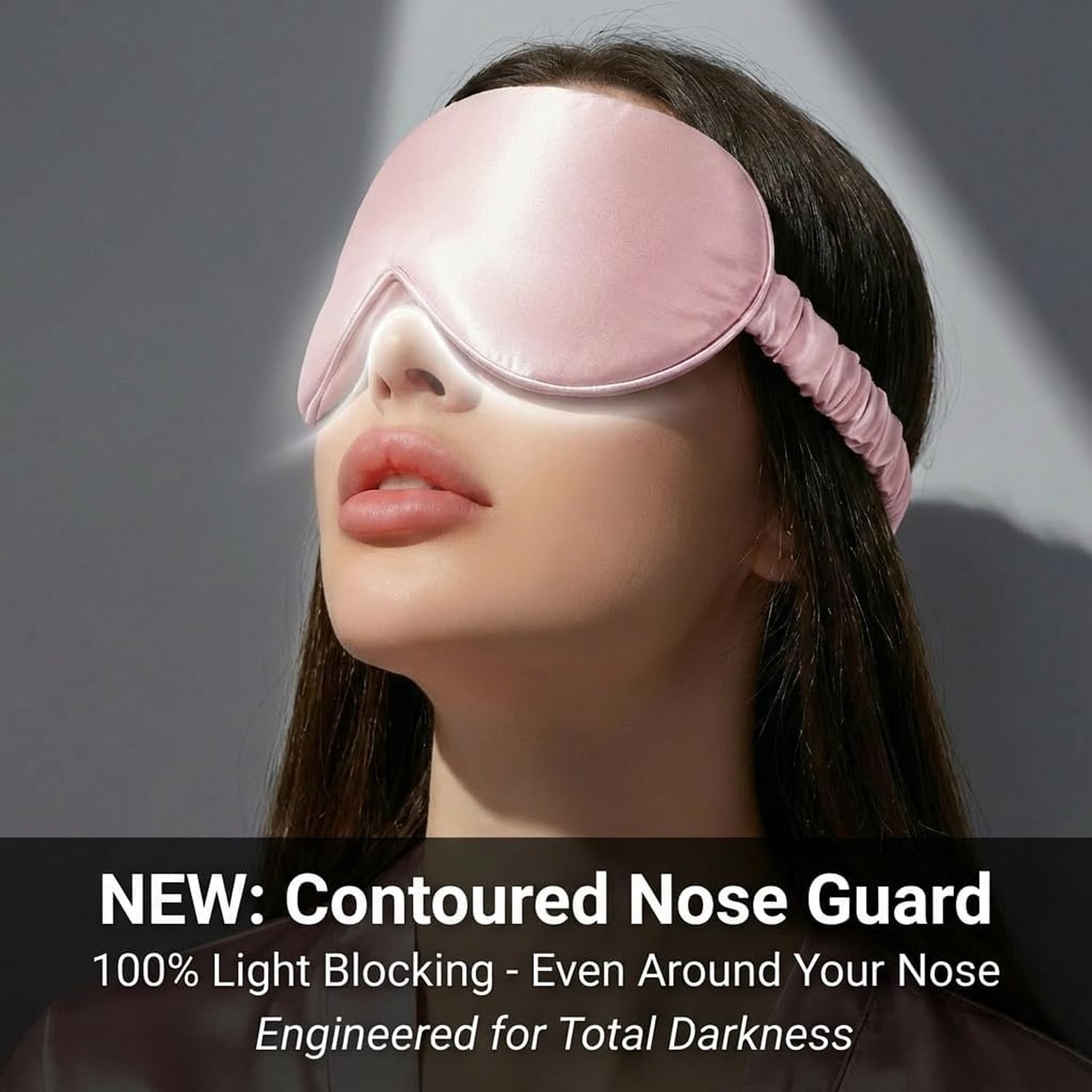
Shift workers and anyone sleeping out of sync with daylight get the most from the shaped nose bridge. Daytime light is far stronger than night-time light, and it finds every gap. A mask that only works in a dim room is not much use at eleven in the morning.
Travellers like it for a simpler reason. It squashes down to nothing, weighs almost nothing, and does not take up the space a padded eye mask does. If you have ever tried to sleep on a red-eye with the cabin lights half on, you know the value of bringing your own darkness.
And then there are the people who just find flat masks annoying. Some of us cannot stand fabric on our eyelids. If you have given up on sleep masks for that reason, the contoured kind is worth one more try.
How to choose
Check the momme number. Anything under 19 momme is thin for a mask. It will be less opaque and it will go limp sooner. 22 is a good working weight.
Look at the strap. Covered elastic beats bare elastic, which pulls at hair. Adjustable beats fixed, because heads vary a lot. The range here is 46 to 66 cm, or 18 to 26 inches, which covers most adults with room at both ends. Set it once and then treat it as a pull-on.
Think about cup depth. Shallower cups than about 10 mm start to touch the lashes of anyone with longer lashes. 14 mm is generous.
Consider the nose. This is the make-or-break detail. A mask with a formed bridge will be noticeably darker than one without, regardless of how good the fabric is.
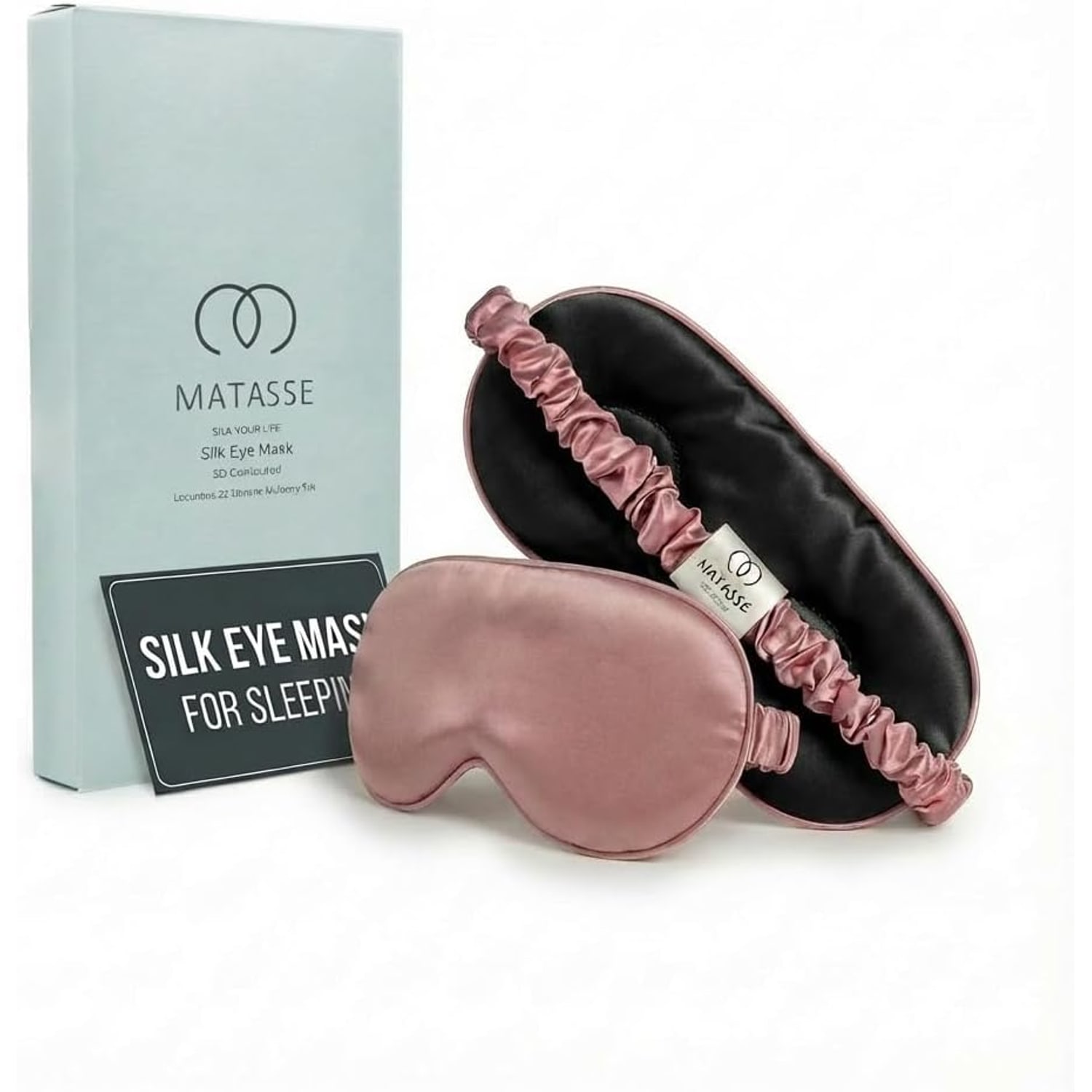
Be realistic about colour. This one is pink with black. It is a cheerful thing rather than a discreet one. If you want something that disappears on a hotel nightstand, that is a different shopping trip.
Decide how much washing you will actually do. Hand wash only is not a suggestion with silk at this weight. If you know yourself and you will throw it in with the towels, buy something else and save the disappointment.
Getting the fit right
Put it on in a bright room first, before bed. Pull the strap so it sits snug but does not leave a mark on your forehead. Then close your eyes and look around. If you see a glow at the nose, slide the mask down a few millimetres and try again. If you see light at the outer corners, the strap needs a touch more tension.
Most people set it slightly too loose on the first night, find it shifts when they turn over, and tighten it the next day. That is normal. Give it three nights before you decide.
If you have long hair, bring the strap below the bun rather than over it. The silk covering means it will slide rather than snag either way, but below sits flatter.
Care, honestly
Fill a basin with cool water and add a small amount of detergent made for delicates. Put the mask in, swish it gently for a minute, leave it a few minutes, then rinse until the water runs clear. Do not wring it. Lay it on a towel, press down to take out the water, then reshape the eye cups with your fingers and leave it flat to dry away from radiators and direct sun.
That whole process takes about four minutes of actual attention. Done every week or two, it keeps the surface smooth and the cups standing.
Things to avoid: bleach, stain removers, tumble dryers, hot irons and the washing machine. Each of these will either flatten the moulded shape or rough up the silk, and neither comes back.
If it creases in a suitcase, hang it in the bathroom while you shower. The steam usually sorts it out without any iron at all.
The short version
A contoured silk sleep mask fixes two specific annoyances that flat masks cannot. It keeps fabric off your eyes and lashes with 14 mm cups, and it closes the light gap at the nose with a shaped bridge. The 22 momme mulberry silk gives it enough body to hold that shape and enough opacity to earn its place.
The strap adjusts from 46 to 66 cm and has no buckle, so it stays comfortable when you sleep on your side. Care is hand wash only and dry flat, which takes a few minutes and makes a real difference to how long it lasts.
If you sleep during the day, travel often, or have simply never got on with fabric resting on your eyelids, this is the shape to try.