
The complete guide
How to Choose a Silk Bonnet That Actually Stays On
The problem with sleeping on cotton
Most of us do not think much about what our hair touches for eight hours a night. It touches a cotton pillowcase, usually, and cotton has a textured weave. Under a microscope it looks like a basket. Hair catches on that texture every time you turn your head, and over a night of ordinary tossing that is a lot of small tugs.
The result is familiar. Frizz on the surface. Flattened curls that took effort to form. Tangles around the nape that take five minutes to work out in the morning. None of it is dramatic on any one night, but it adds up into a routine of fixing hair that was fine when you went to bed.
A silk bonnet solves this by changing the surface. Silk is a smooth, continuous filament rather than a spun staple fibre, so the fabric it makes has far less grab than cotton. Hair slides across it instead of snagging on it. That is the whole mechanism. No treatment, no coating, just a different fabric.
What momme weight tells you
Silk is sold by momme, not thread count. The number describes how much a standard piece of the fabric weighs, and higher means denser and heavier. You will see silk accessories anywhere from about 12 momme up to 30.
At the low end, around 12 to 16 momme, the silk is thin and translucent. It feels light and it is cheap to make, which is why a lot of budget bonnets live there. It still feels smooth, but it collapses on your head and it wears through faster.
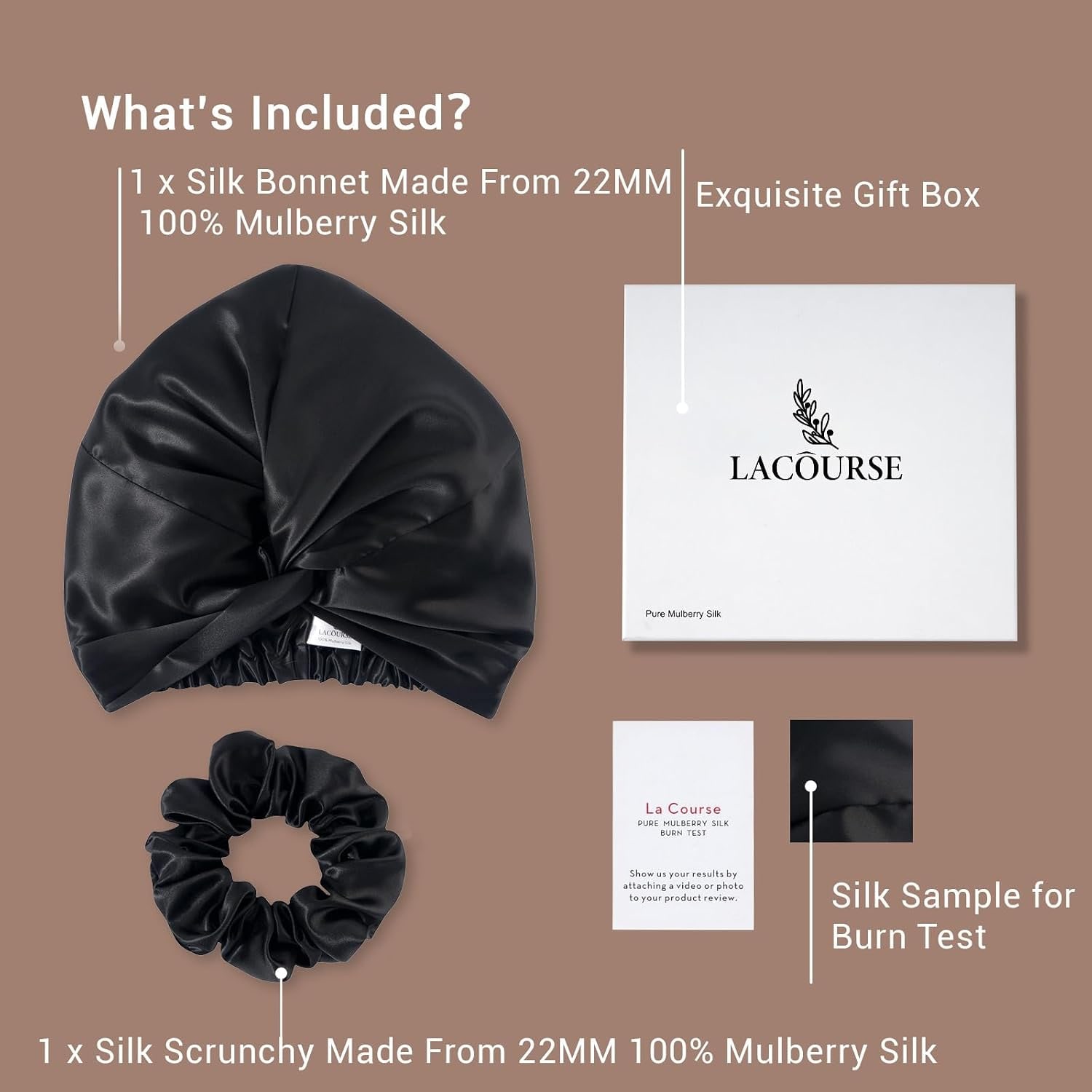
This bonnet is 22 momme. That is a solid, substantial silk. It has enough weight to hold its shape when you put it on, enough body that it does not cling flat to your scalp, and enough density that it will take regular washing without going thin at the seams. If you have handled a good silk pillowcase, 22 momme is roughly that same hand feel.
Above about 25 momme the silk starts to feel quite heavy for a sleep cap. It is lovely for bedding but it can be warm on your head. For a bonnet, the low twenties is the sweet spot most people land on.
Why two layers matters
Plenty of bonnets advertise silk and deliver silk on one side only. The outside is silk, the inside is polyester, and the inside is the part doing the actual job. It is a common corner to cut because nobody checks the lining in a photograph.
This one is double layer, and both layers are 100% mulberry silk. So the surface against your hair is silk, and the surface against your pillow is also silk. That second part is less talked about but it helps the bonnet glide on the pillowcase rather than dragging and twisting, which is one of the reasons bonnets work loose overnight.
Two layers also gives the cap more structure. A single thin layer flops. Two layers of 22 momme sit properly over your hair and keep a little bit of space, which is what you want if you are protecting a curl pattern or a set.
Getting the fit right
The most common complaint about any sleep bonnet is that it ends up on the pillow by morning. The second most common is a red line across the forehead. Both come down to how the bonnet holds on.
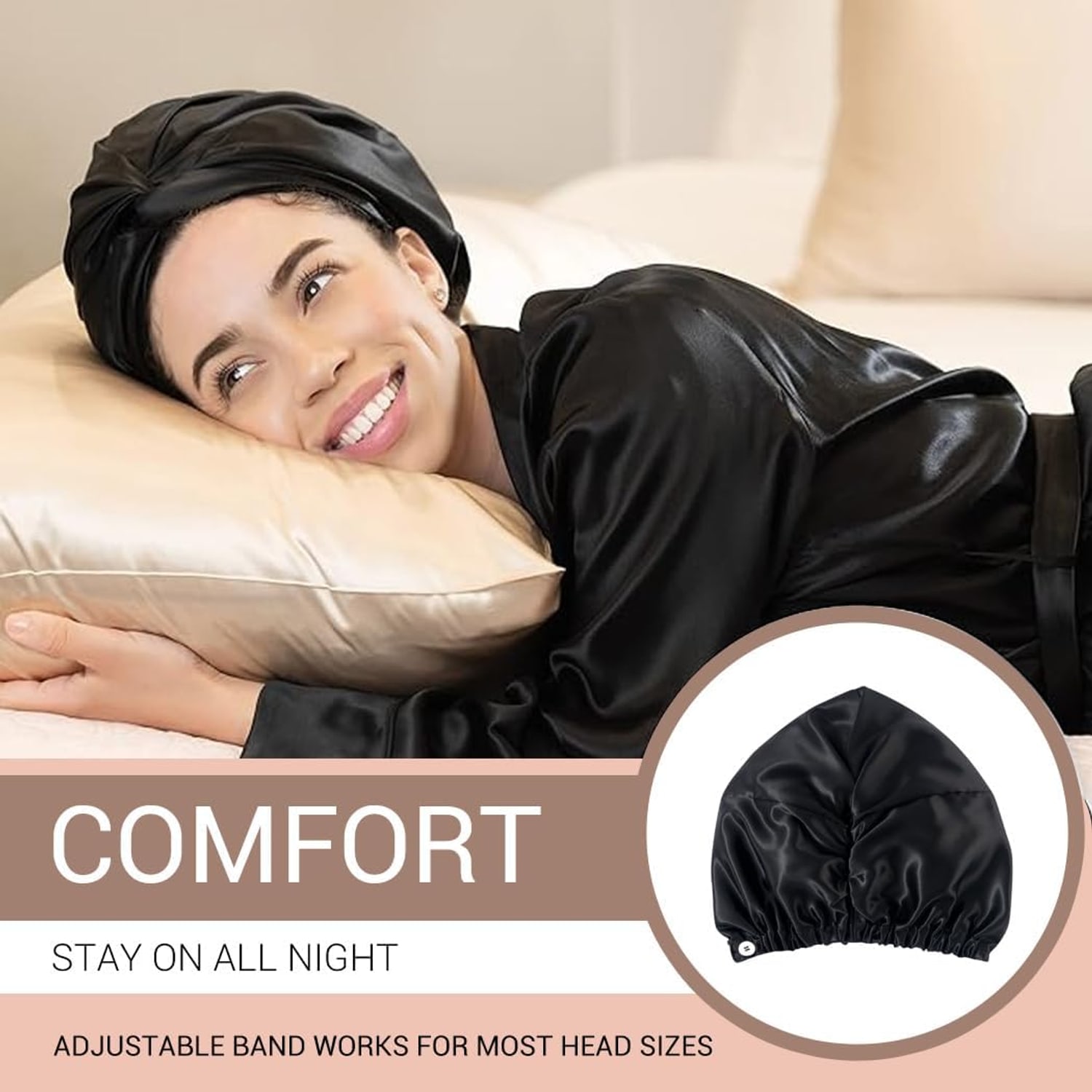
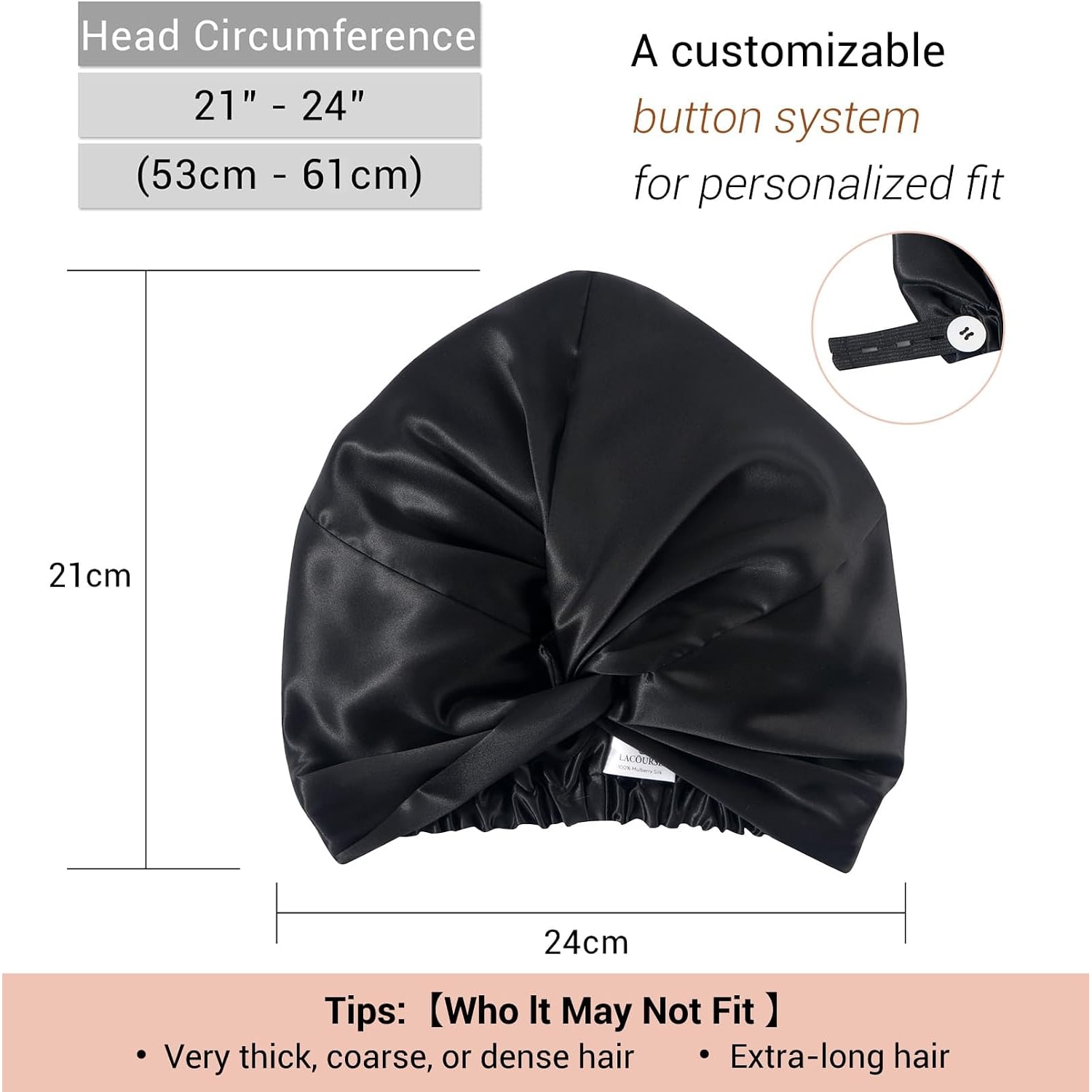
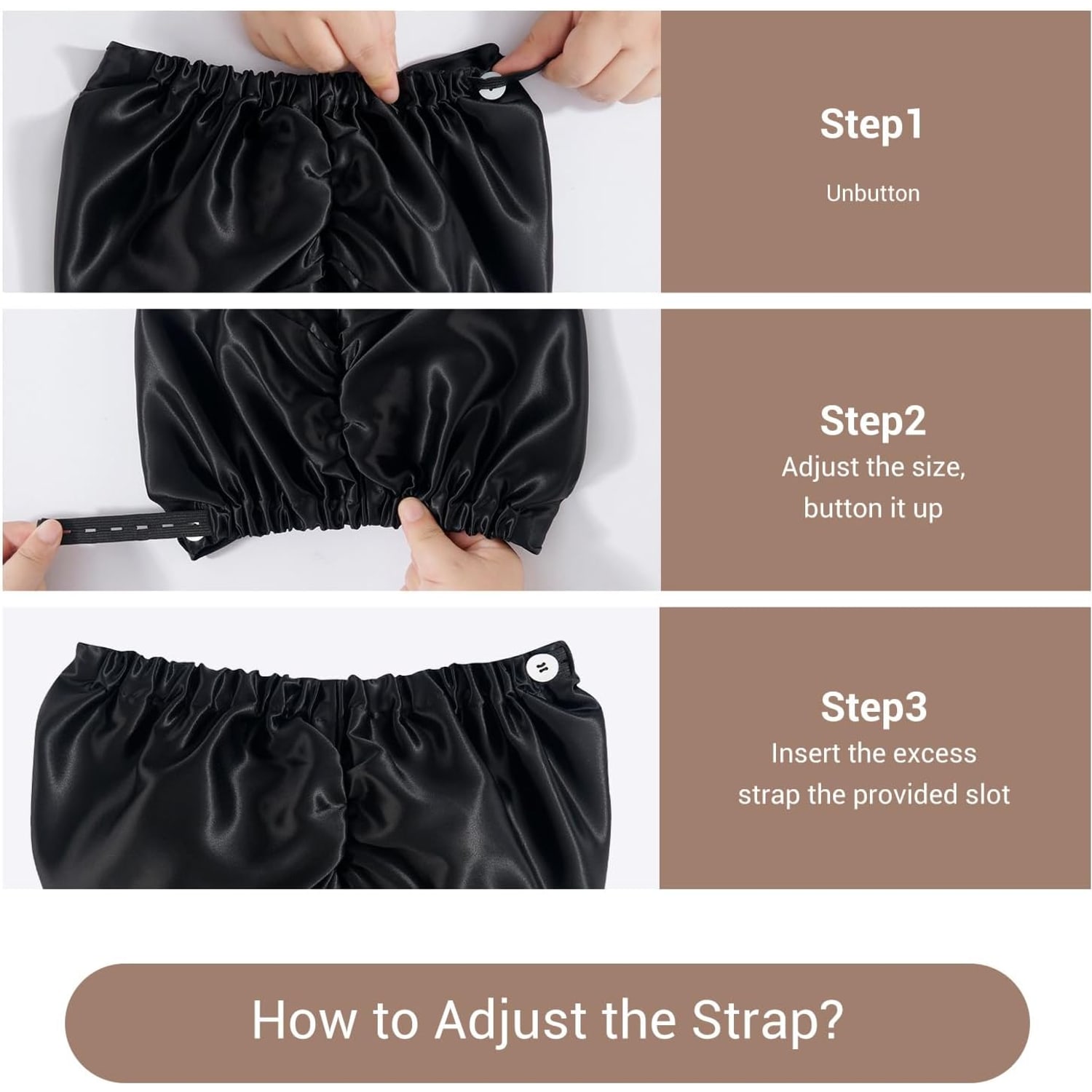
A fixed elastic band is one size of tension for every head, which means it is too tight for some and too loose for others. An adjustable closure, which is what this bonnet uses, lets you set it yourself. The trick is to tighten it mainly at the back, around the nape, and leave the front relaxed. The nape is where a bonnet slips from. Get that secure and the front does not need to grip at all.
Give it two or three nights before you decide. Most people adjust a notch tighter after night one, then leave it alone permanently.
The flat measurement is about 26 by 24 cm. That gives you a sense of the internal volume. If you want to check, pop a tape measure over your crown and down to just above your ears. It is a rough test but it tells you whether you are in the ballpark.
Who it suits, and who it does not
The maker is upfront here, and that is worth repeating. It suits short to long hair, and it handles curls and waves. It is not recommended for very thick or voluminous hair.
That honesty is useful. If you have a large braided set, long locs, a very dense wash-and-go, or a big twist-out you want to preserve at full volume, this cap will compress it. You want a deeper, wider style for that, or a scarf wrap. There is no point squeezing hair into a bonnet that is too small, because the compression undoes the point of wearing one.
For straight hair, wavy hair, looser curl patterns, bobs, lobs, and medium to long hair worn loose or in a pineapple, there is room. Gather hair loosely on top first, settle the bonnet over, adjust the back, done.
Living with silk
Silk has a reputation for being fussy. It is not really, it just dislikes three specific things: hot water, harsh detergent, and the tumble dryer.
Wash it in cool water with a mild detergent made for delicates. By hand is easiest, two minutes in the sink, but a gentle machine cycle inside a mesh laundry bag is fine too. Skip bleach entirely and skip fabric softener, which leaves a film on silk and dulls the surface.
Do not wring it. Lay it in a towel, press gently, then reshape it and leave it flat to dry somewhere out of direct sun and away from a radiator. It dries quickly. If you want it crisp, iron on the lowest silk setting, on the reverse side.
With black silk, wash it separately the first couple of times. That is standard sense with any dark dyed fabric and costs you nothing.
How often? Every week or two is a reasonable rhythm. Sooner if you use oils or leave-in products overnight, since those transfer to the fabric and build up.
The scrunchie is not just a freebie
It is easy to dismiss an included accessory, but a matching silk scrunchie gets more use than you would think. If you tie your hair back before the bonnet goes on, the tie itself is a friction point. A silk scrunchie removes it. It is also wide and soft, so it does not leave the crease a thin elastic does.
During the day it works as an ordinary hair tie, and it lives happily on your wrist. Wash it alongside the bonnet in the same bag.
Building a routine around it
A bonnet does not need to be part of an elaborate system. Put it on last thing, take it off first thing. That is enough for most people.
If you want more from it, a few small habits help. Let hair dry to at least slightly damp before putting the bonnet on, because silk does not wick moisture the way a towel does. Gather longer hair loosely on the crown rather than letting it pile at the nape, where it gets compressed. And if you are protecting a style, set the bonnet on from the front of your hairline and roll it back, which keeps the shape instead of flattening it.
The short version
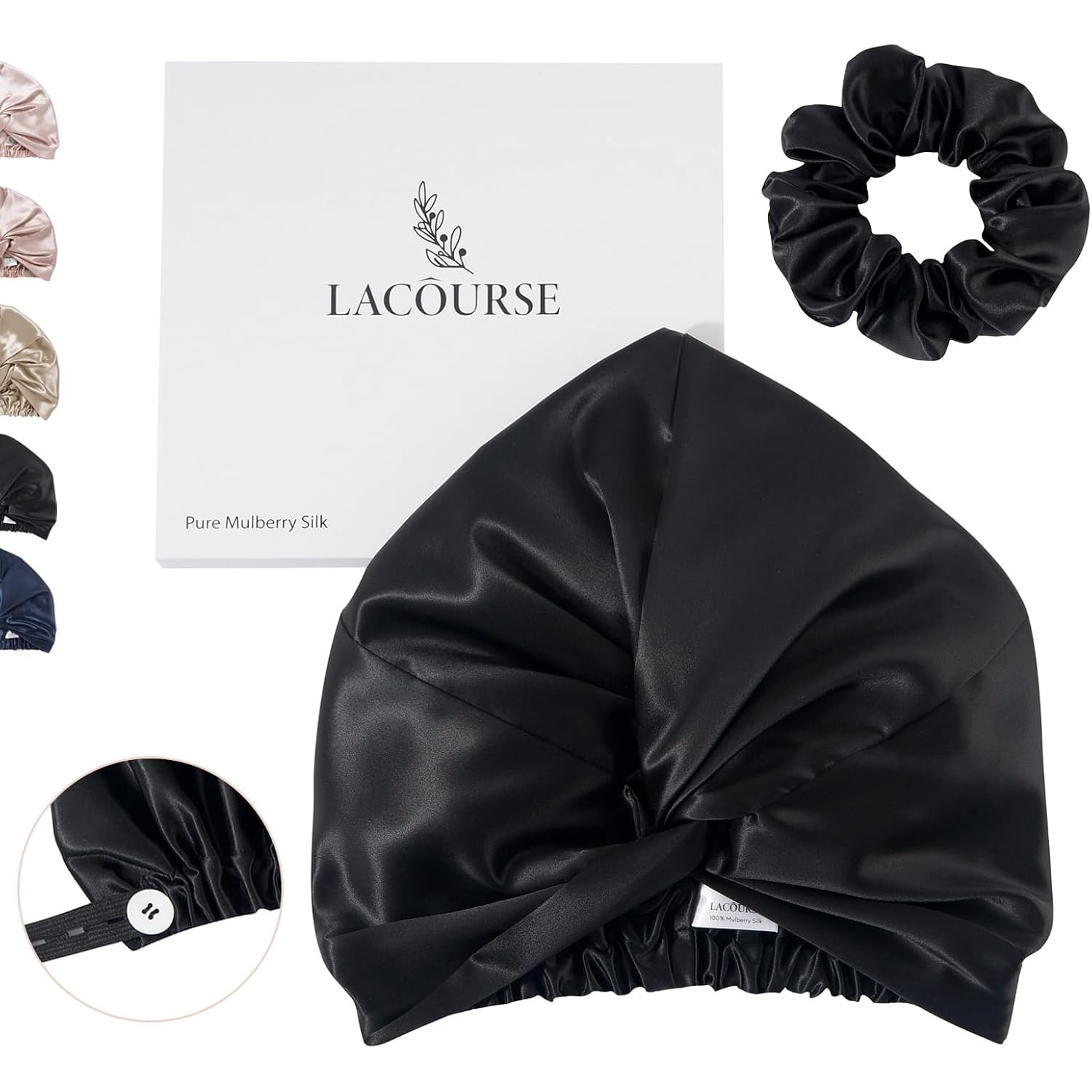
This is a black sleep bonnet in two layers of 22 momme, 100% mulberry silk, with an adjustable closure and a matching silk scrunchie in the box. It measures about 26 by 24 cm laid flat.
The 22 momme weight means it feels substantial and should last. The double silk construction means the layer touching your hair is the real thing, not a lining. The adjustable closure is what keeps it on your head without pinching.
It is a good fit for short to long hair, curls and waves. It is not the right choice if your hair is very thick or very voluminous, and the maker says so plainly, which is the sort of thing worth listening to before you buy.