
The complete guide
How to Choose a Silk Pillowcase, Without Overthinking It
The problem with a normal pillowcase
Nobody really thinks about their pillowcase. It is a square of cotton, you wash it with the sheets, you put it back on. But you spend somewhere near a third of your life with one side of your face pressed into it, and cotton is not a smooth fabric. Look at a cotton weave closely and you see a grid of raised threads. That texture grips. Hair catches in it, skin drags against it, and every time you turn over, the fabric pulls a little instead of letting you slide.
Silk does not do that. The filament is long and even, and the woven surface is far smoother, so hair and skin move across it rather than snagging on it. That is the whole pitch. It is not complicated, and it is not magic. It is just a different surface to sleep on.
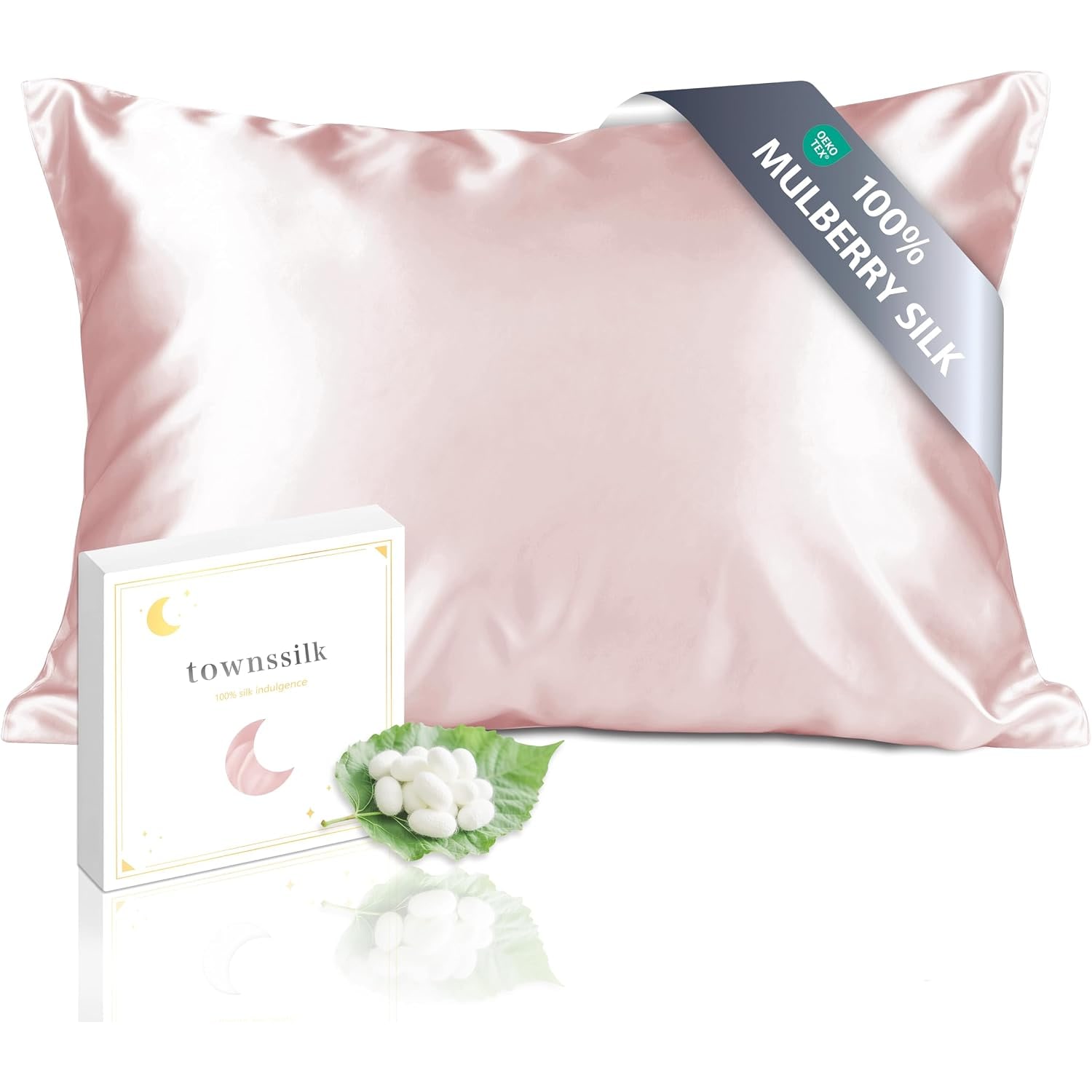
This particular pillowcase is 100% mulberry silk, woven at 19 momme, in a soft dusty pink, sized 50 x 75 cm with a hidden zip. The rest of this guide explains what those details mean and how to decide whether they suit you.
What momme actually tells you
Momme is the unit the silk trade uses to describe fabric weight. It works a bit like GSM does for cotton. A low momme number means a thin, light cloth. A high number means a denser, heavier one.
For bedding, you will mostly see three numbers quoted. Sixteen momme is on the light side, cheap and perfectly usable but thinner than many people expect. Nineteen momme is the middle of the road and the most common choice for a standard silk pillowcase. Twenty-two momme is the heavy end, noticeably denser under the hand, and usually the most expensive.
Nineteen momme hits a sensible balance. It has enough body to lie flat on the pillow instead of rippling, it feels properly silky rather than papery, and it does not carry the price jump of the heaviest weaves. If you are shopping for the best 19 momme silk pillowcase, that is the reasoning most people land on.
You will also see thread count quoted on silk, as it is here at 600. Treat it as secondary information. Thread count is counted in different ways by different mills, and it was never really designed as a measure for silk in the first place. Momme is the number to compare.
Grade 6A and what mulberry means
Mulberry silk comes from silkworms that are fed only mulberry leaves. That controlled diet produces a long, uniform filament, which is why mulberry silk is the type used for fine bedding rather than the shorter, coarser silks used elsewhere.
Grade 6A is a maker grading for filament quality, taking into account things like length and evenness. The maker lists this fabric as 6A. It is a trade classification rather than an independent certification, so it is worth knowing what it is and what it is not. The useful facts here are that the fabric is 100% mulberry silk and that it is woven at 19 momme.
Getting the size right
This is where most returns come from, so it is worth two minutes with a tape measure.
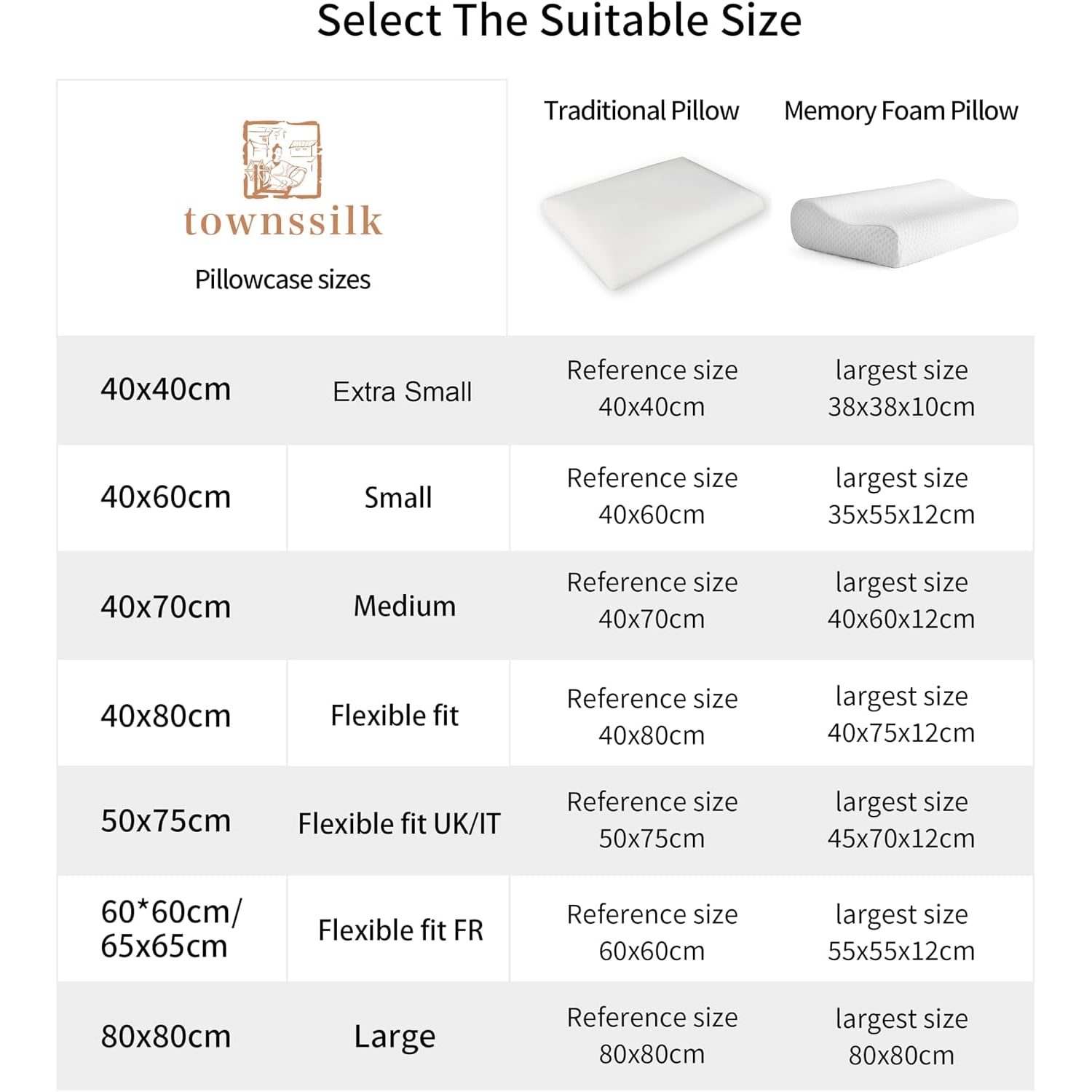
In Ireland and the UK, a standard pillow is around 50 x 75 cm, which is about 20 x 30 inches. That is what this pillowcase is cut for. If you bought your pillows locally and did not go looking for anything unusual, they are almost certainly standard.
Continental pillows are different. They come in 50 x 70 cm, and in a 65 x 65 cm square. A 50 x 75 cm case on a 50 x 70 cm pillow will leave 5 cm of slack, and on a square pillow it will not go on at all. Hotel-style and king pillows are longer again.
So measure. Lay the pillow flat, run the tape across the width and then the length, and compare. A pillow slightly smaller than the case is fine, the silk just sits a little loose. A pillow larger than the case will strain the seams and the zip, which is the fastest way to damage a silk pillowcase.
Why the zip matters more than you think
There are two ways pillowcases close. An envelope style has an internal flap that you tuck the pillow behind. A zip closure has a proper zip, usually hidden in a seam along one edge.
Envelope flaps are cheaper to make and they look tidy at first. The problem shows up after a few nights, when the pillow has shuffled its way out and the flap is sitting half open at the end of the bed. Then it happens again in the wash, where the case unrolls and wraps itself around whatever else is in the drum.
A zip solves both. The pillow stays where you put it, and the case comes out of the machine as a case rather than a tangle. Because the zip here is set into the seam rather than sitting proud of it, you do not feel it under your cheek. If you have been comparing pillowcases and wondering whether the closure is worth paying attention to, this is the part that affects daily use most.
The colour
Dusty pink is a muted rose. It is not a bright pink, and it is not a pale baby pink either. It reads as a warm neutral, which is why it works against white, ivory, grey, beige and natural linen rather than fighting with them.
Silk has a natural lustre, so the shade moves as the light does. Where the fabric folds it looks a little deeper, and where it catches the light it looks lighter. That shifting quality is part of why silk looks the way it does. It also means screen photos never quite capture it, so expect the real thing to be slightly softer than the picture.
Looking after it
Silk is less fragile than its reputation suggests, but it does want a gentler routine than cotton.
Wash it in cool water, either by hand or on the gentle cycle, with a mild detergent meant for delicates. Regular biological powders contain enzymes designed to break down protein, and silk is a protein fibre, so stick to something mild. Skip the bleach and skip the fabric softener, which coats the fibres and dulls the surface you paid for.
Put it in a mesh laundry bag if you are machine washing. That keeps it away from zips, hooks and anything else that could snag.
Do not wring it out. Press the water out between your hands or roll it in a towel. Then dry it flat or hang it in the shade. Direct sun and radiator heat are the two things that age silk fastest, and sunlight is also what pulls colour out of a dyed fabric over time.
Ironing is optional. If you want it crisp, use the lowest setting on the reverse side while the fabric is still slightly damp. Most of the time it falls smooth on its own once the pillow is inside.
Washed this way, a pure silk pillowcase holds up for years of regular use.
Who it suits
People with long hair often come to silk first, because the smoother surface means fewer snags and less bedhead in the morning. People who sleep hot tend to like the cool initial feel of the fabric. And a good number of buyers simply want their bed to feel a bit nicer, which is a perfectly good reason on its own.
It also makes a straightforward gift. A silk pillow cover is the kind of thing people enjoy and rarely buy for themselves, and a muted shade like this one fits most bedrooms without having to ask about anyone's colour scheme.
The short version
This is a single pillowcase in 100% mulberry silk, 19 momme, standard 50 x 75 cm size, dusty pink, with a hidden zip. Measure your pillow before ordering, wash it cool and gently, keep it out of strong sun, and it will stay good for a long time.
Delivery is tracked and takes 5 to 8 working days, free over 120 euro and 15 euro below that. If it is not right, you have 14 days from delivery to send it back.