
The complete guide
How to Choose Silk Scrunchies That Actually Last
The small annoyance nobody talks about
Hair ties are one of those things you buy without thinking, lose constantly, and never really evaluate. You grab a bag of twenty from the chemist, they do the job for a few weeks, then they stretch out, the metal crimp catches, or the dye runs onto your wrist in the rain. Nobody complains loudly about hair ties because they cost almost nothing. But the daily friction adds up, especially if you wear your hair up five days a week.
Silk changes that equation a bit. It is not magic and it is not a cure for anything, but it is a genuinely different surface. Silk fibre is smoother and more even than cotton fibre, which means hair moves across it rather than gripping it. That is the entire practical argument for silk hair ties, and it is enough of an argument that most people who switch do not go back.
What momme actually tells you
If you shop for silk anything, you will meet the word momme. It is a weight measure, written as a number followed by mm or the word momme. Higher numbers mean a denser, heavier fabric with more silk in it per square metre.
Light silks sit around 12 to 16 momme. They are fine for scarves and linings. Mid weight runs roughly 19 to 22, which is where most good pillowcases and accessories land. Anything above 25 starts to get stiff for something that needs to gather and stretch.
This set is 22 momme, which puts it at the heavier end of the useful range for a scrunchie. In your hand that means a fabric with some weight to it, one that falls into folds instead of crinkling. When it is wrapped around a ponytail, a 22 momme scrunchie holds a rounded, full shape. A thin one goes flat.
The listing also gives a grade of 6A. Silk grading runs from A up to 6A, and it refers mostly to the length and consistency of the fibres in the thread. Longer, more uniform fibres make a smoother, more even fabric with fewer slubs. It is a maker grading rather than an independent standard, so treat it as a description of quality tier rather than a certificate.
How a silk scrunchie is built
Underneath the fabric is an elastic core. That is the part doing the work. The silk is a casing gathered along the elastic, which is why a scrunchie puffs out when it is relaxed and flattens as you stretch it.
This construction matters more than people realise. With a bare elastic or a thin covered band, the pressure of the hold is concentrated along a narrow line. With a gathered casing, that same pressure spreads across a much wider contact area. Less pressure per millimetre means less of a hard crease when you take your hair down, and less of a sore spot if you wear it all day.
It also means the material you choose for the casing is the material touching your hair. Cotton casings are breathable but have a raised, fibrous surface. Polyester satin is smooth but can feel plasticky and tends to pill. Mulberry silk is smooth, soft and keeps its finish for longer, which is what you are paying for.
Who these suit
If you wear your hair up most days, you will notice the difference quickly. The same goes for anyone who ties their hair back for work, for driving, for cooking, or for the gym changing room afterwards.
Thick hair tends to do well with gathered silk bands because of that wider contact area. If you have a lot of hair, you may use two scrunchies for a high ponytail, which is normal and not a sign the band is weak. People searching for the best scrunchies for thick hair usually end up with a gathered fabric band for exactly this reason.
Fine hair is a slightly different story. Smooth surfaces are smooth in both directions, so a silk band can slip if you only loop it twice. The fix is simple. Twist the hair once before the final loop, or add one more wrap than you would with a rubber band. After a day or two it becomes automatic.
Curly and textured hair routines often avoid rough fabrics, and silk is a standard choice in those routines. Use it for a loose pineapple at night rather than a tight band.
Choosing between three colours
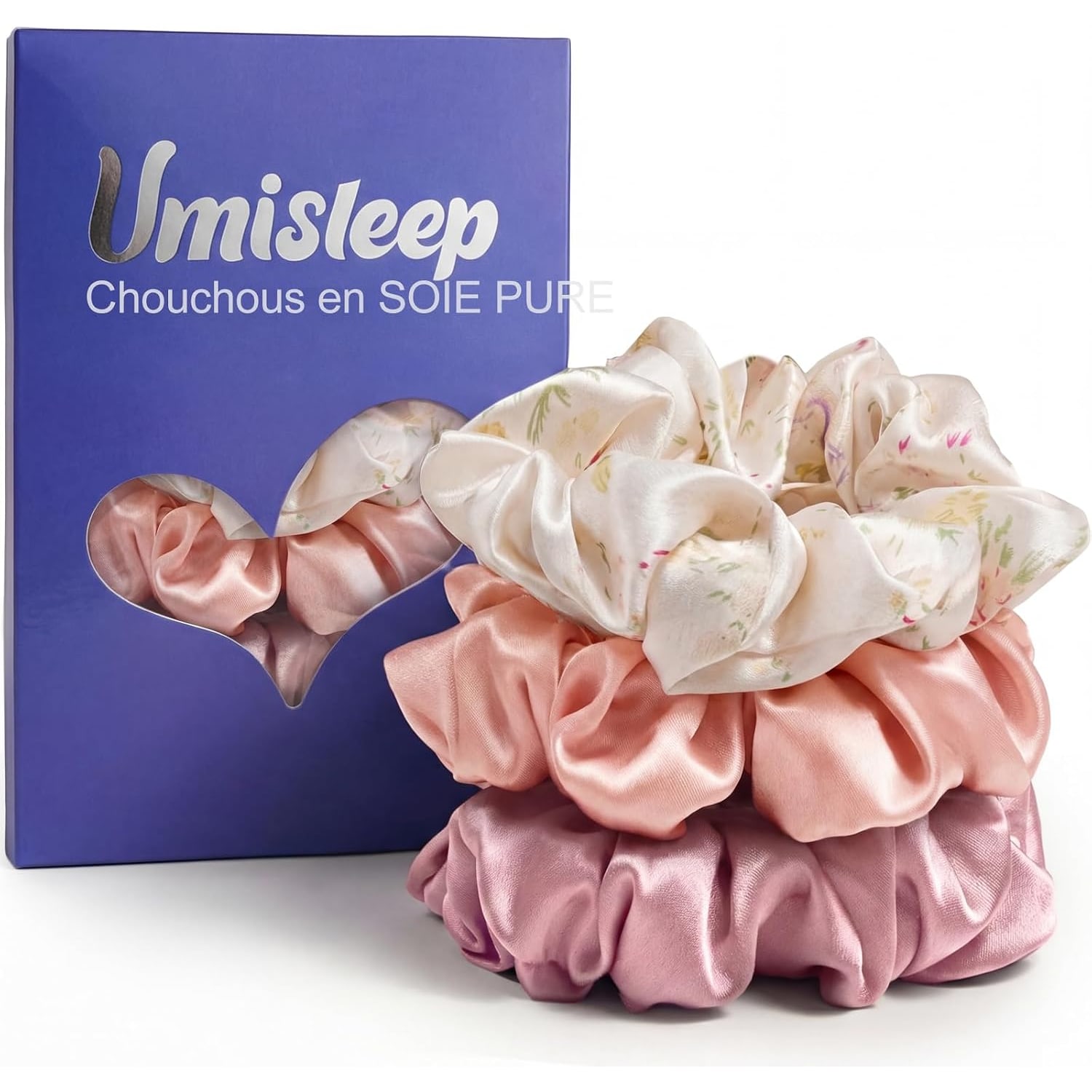
The set includes a cream print, a soft pink and a dusty rose. In practice most people have a favourite within a week, and it is usually the neutral.
The cream print is the one that disappears against most outfits. It reads as a small decorative detail rather than a statement. The soft pink is lighter and brighter, better with pale clothes and summer colours. The dusty rose is the muted option, a bit more grown up, and it holds up well against navy, grey and black.
Having three also solves the hair tie disappearing act. One lives in your handbag, one stays in the bathroom, one is on your wrist. You stop losing them because there is always another within reach.
Looking after them
Silk is not fragile, but it does not forgive heat. Treat these the way you would treat a good silk scarf and they will keep their finish for a long time.
Hand wash in cool water with a detergent made for delicates. Swirl the scrunchie around rather than scrubbing it, then rinse it in clean cool water. Do not wring it out, as twisting stresses both the fibre and the elastic inside. Press it flat between a folded towel to get the water out, then lay it somewhere out of direct sun to dry.
Skip the tumble dryer entirely. Heat tires the elastic faster than anything else, and it dulls the silk surface. If the scrunchie looks creased when it dries, a cool iron on the reverse sorts it out.
One habit worth building: rotate all three rather than wearing the same one every day. Elastic recovers better when it gets a rest, so spreading the wear across three bands means all three last longer than one worn constantly.
Wash them separately for the first wash or two. Any dyed silk can release a little colour at the start, and you do not want the dusty rose ending up on a white shirt.
What to watch for when comparing sets
Not everything sold as a silk scrunchie is silk. A lot of listings say satin, which is a weave rather than a fibre, and satin is usually polyester. If a listing does not state a fibre content and a momme weight, that is usually because the numbers would not help the sale.
Check the elastic too. A cheap set uses a thin, weak elastic that gives out long before the fabric does. A visible seam that is bulky or rough is another sign of a rushed make.
Finally, think about how many you need. Buying one good scrunchie and losing it is the worst outcome. A set is the practical choice, which is why the best gift set of scrunchies is nearly always three or more.
The short version
This is a set of three mulberry silk scrunchies in a cream print, a soft pink and a dusty rose. The silk is 22 momme, grade 6A, gathered over an elastic core. That combination gives you a band with some substance, a smooth surface for hair to slide over, and a wide contact area that holds without digging in.
Hand wash them in cool water, dry them flat, keep them away from heat, and rotate between the three. Done that way, a set like this outlasts several bags of supermarket elastics and looks considerably better on your wrist in the meantime.