
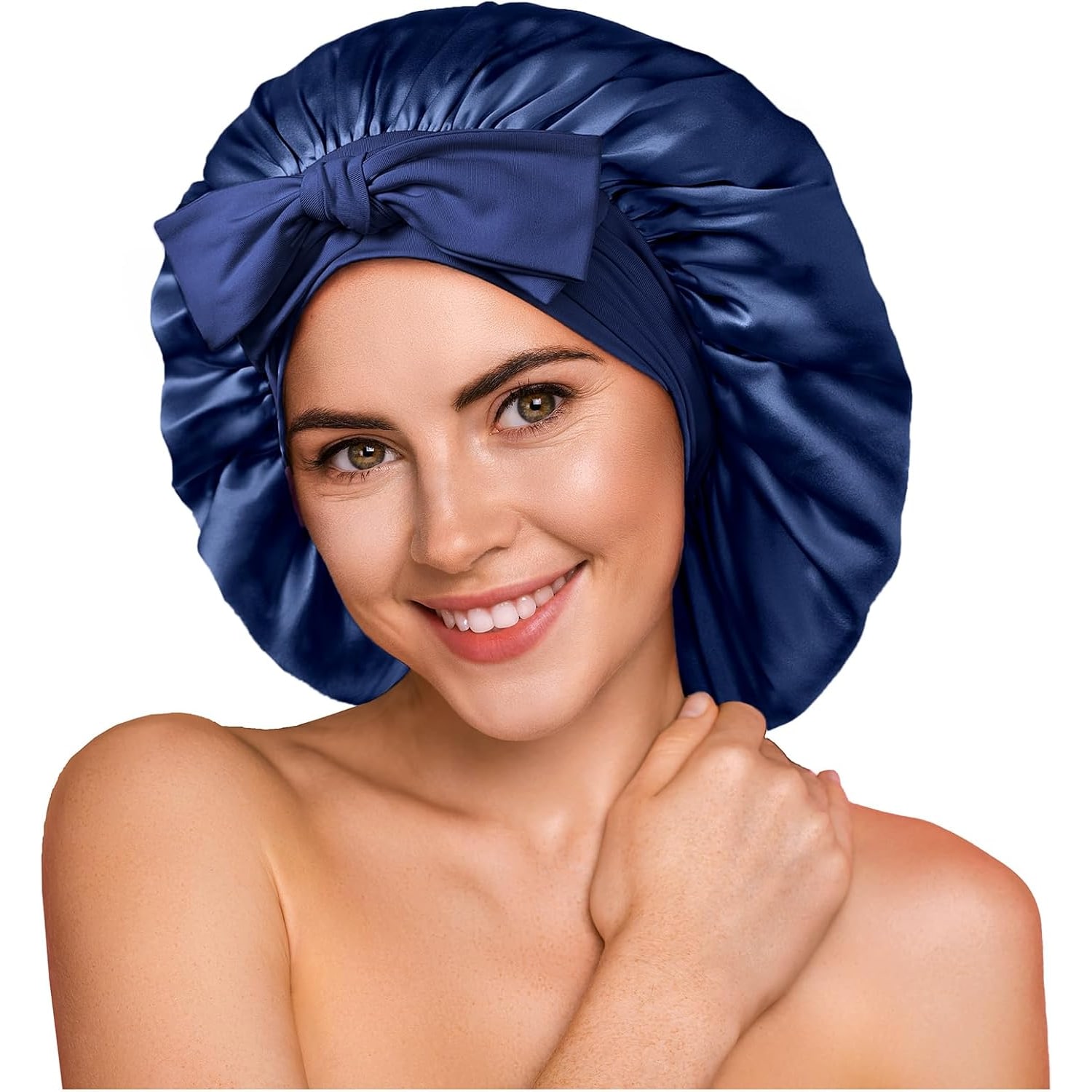
The complete guide
How to Choose a Silk Bonnet That Actually Stays On
The problem with waking up to flat, fuzzy hair
You go to bed with your hair looking decent. You wake up and one side is pressed flat, the ends look roughed up, and if you had braids or a twist-out, the definition has gone soft and fuzzy. Nothing happened except seven hours of your head moving against a pillow.
That is friction. Cotton bedding, even good cotton, has a textured surface at a microscopic level. Every time you turn over, your hair drags across it. Multiply that by a few hundred movements a night and a few hundred nights a year, and you get exactly the result most people complain about, which is hair that never quite looks the way it did when they styled it.
A bonnet solves it in the simplest possible way. It puts a smooth surface between your hair and everything else. Your hair moves against silk instead of cotton, and silk is a long, smooth filament rather than a short, textured one, so there is far less drag.
What 22 momme and grade 6A actually mean
These two numbers get thrown around a lot, and they measure different things.
Momme is a weight measure, borrowed from the Japanese silk trade. It tells you how heavy a fixed area of the fabric is. Lower momme silks, around 16, feel light and slightly flimsy. Higher momme silks, 22 and above, have body. They drape properly, they feel substantial in the hand, and they tend to hold up better to washing. At 22 momme, this sits in the weight range most people land on when they want a silk that feels like a real textile rather than a lining.
Grade 6A refers to the raw silk filament itself. The grading scale runs A, 2A, 3A and so on up to 6A, and it reflects how long, even and clean the filament is. Longer, more uniform filaments weave into a smoother and more consistent cloth with fewer slubs. So 6A is the top grade in common use.
Put together, 22 momme and grade 6A describe a fabric with decent weight and good filament quality. Neither number alone tells the whole story, which is why it is useful to see both.
Why double layer matters more than people realise
Here is a thing worth knowing when you shop for the best mulberry silk bonnet. A lot of bonnets are described as silk, and they are, on the outside. The lining that actually touches your hair is often polyester satin. Satin is a weave, not a fibre, so "satin lined" tells you nothing about what the material is.
This bonnet is a double layer of silk. Both the outer and the inner are mulberry silk. That matters because the inner surface is the one doing the work. If your hair is resting against polyester all night, the silk on the outside is mostly doing a job for your pillowcase.
The second benefit of two layers is structure. A single-layer cap can feel insubstantial and collapse against your head. Two layers hold a little more shape, which helps the cap sit over your hair rather than squashing it.
The band is the part that decides everything
Ask anyone who has given up on bonnets why they stopped, and the answer is almost always that it came off in the night, or that it left a red line on their forehead.
Both problems come down to the band.
Thin elastic concentrates all its pressure into a narrow strip. That is what marks your skin. It also tends to either grip too hard, which is uncomfortable, or too lightly, which means the cap migrates off your head by 3am. And elastic degrades. After a few dozen washes it slackens, and a bonnet that fit fine in January is sliding off by June.
A wide tie band behaves differently. The width spreads the pressure out over a broader area of your forehead and nape, so you are far less likely to get a mark. And because you tie it, you choose the tension every single night. Loose on a warm night, snugger when you are sleeping restlessly. The tie also does not wear out. A knot in January is a knot in June.
The trade-off is a few extra seconds getting it on. For most people that is a fair swap for something that actually stays put.
Getting the size right
This is an L-XL, roughly 33 cm (13 inches) across. That is a genuinely roomy cap, and the size exists for a reason.
If you have long hair, you need somewhere for the length to go. If you have thick, curly or coily hair, you need volume, because compressing a curl pattern flat against your scalp for eight hours undoes everything you did to define it. If you sleep in braids, twists, or rollers, you need the cap to clear the style rather than press down on it.
For all of those, larger is better. Those looking for the best large silk bonnet or the best silk bonnet for long hair should be aiming at this end of the range.
If your hair is short or fine, you will have spare fabric. That is not a fault, it just means you gather a bit more when you tie. Some people with short hair deliberately pick a bigger cap because it is more comfortable to sleep in and does not sit tight on the skull.
A quick way to check: style your hair the way you normally would at bedtime, then measure across the widest point. If that number is comfortably under 33 cm, you are fine. If you are right on the line, go roomier. A slightly loose bonnet that you tie down is better than a tight one that pops off.
How to actually put it on
Gather your hair at the crown if it is long. Loosely, not in a tight bun, because a tight bun creates a pressure point and a crease. Hold the cap open, tip your head forward slightly and bring the cap up and over from the nape. Settle the band so the wide part sits flat against your forehead and the back sits at the base of your skull. Then tie at the front.
If it still slides, try moving the band a little lower at the back. The nape gives the band more to hold onto than the crown does.
Caring for silk so it lasts
Hand wash only. That is the stated care, and it is worth following.
Cool water, a small amount of a mild detergent made for delicates, and a gentle swirl. Do not scrub, do not wring, do not twist. Rinse in clean cool water, then press the water out by rolling it in a dry towel.
Dry it flat on a towel or hang it somewhere airy. Keep it out of direct sunlight and away from radiators. Heat and UV are what dull silk's finish over time, far more than washing does.
Skip the bleach, skip the tumble dryer, and if you ever need to press it, use the lowest iron setting on the inside of the fabric.
How often? Every week or two is reasonable for most people. If you apply oils, leave-in creams or treatments at night, wash more often, because product build-up is what makes silk start to feel sticky instead of slippery. A clean bonnet is a slippery bonnet, and slippery is the whole point.
A few honest expectations
A bonnet reduces friction. That is a material fact about how silk behaves compared with cotton, and it is the reason to buy one. It is not a treatment and it does not replace whatever your hair routine already is.
It also takes a few nights to get used to. Almost everyone finds a bonnet slightly odd for the first two or three nights and then stops noticing it entirely.
And it will not make a styled look last forever. It helps a twist-out hold its definition for an extra day or two, which over a week is a meaningful difference in how much time you spend restyling.
The short version
This is a blue sleep bonnet in 100% mulberry silk, 22 momme, grade 6A, built in two silk layers rather than silk over a synthetic lining. It closes with a wide band that ties at the front, so the tension is yours to set and it will not slacken the way elastic does. The size is L-XL at about 33 cm (13 inches) across, which suits long hair, thick or coily hair, braids, twists and rollers.
Care is hand wash only, cool water, dried flat away from heat.
If you have been waking up to flattened, fuzzy hair and you want the simplest fix, this is it. Measure your styled hair, pick roomy if you are between sizes, and tie the band only as firmly as you need.