



The complete guide
How To Choose A Silk Sleep Cap That Actually Stays On
The problem with waking up to a nest
You go to bed with your hair looking reasonable. Eight hours later it is a different story. Curls have gone flat on one side, the ends are rough, and whatever you did before bed has been undone by a pillow.
A lot of that comes down to friction. Cotton is a thirsty, slightly grabby fibre. As you turn over, your hair catches and drags against it. Over one night it is nothing much. Over a few hundred nights it adds up, especially at the ends where the hair is oldest and most fragile.
Silk behaves differently. The fibre is smooth and the weave is tight, so hair slides across it instead of catching. That is the whole idea behind a sleep cap. You are not treating your hair with anything. You are just removing the thing that has been roughing it up every night.
What 22 momme actually tells you
Silk is sold by momme, written as mm but pronounced "mommy". It measures the weight of the fabric. The higher the number, the denser the cloth.
Lightweight silk sits around 12 to 16 momme. It feels nice but it is thin, and thin silk tends to wear through at the seams faster. At the other end, 25 momme and above is heavy and lovely but costs considerably more.
Twenty-two momme sits in the useful middle. It has enough body that it does not feel like a tissue, it holds its shape, and it stands up to regular washing. When people search for the best mulberry silk bonnet, 22 momme is the weight that comes up most, and for good reason.
Mulberry silk, by the way, refers to the type of silkworm and what it eats. Bombyx mori worms fed on mulberry leaves produce long, even, pale filaments. That evenness is what gives the finished fabric its smooth hand.
Why the lining matters more than the outside
Here is the thing to check on any bonnet you are comparing. Plenty of caps are described as silk, and the outer shell genuinely is. The lining, the part touching your hair all night, is sometimes polyester or satin-finished cotton.
Satin is not a fibre. It is a weave. You can weave polyester into satin and it will be shiny and feel slippery, but it does not breathe the way silk does and it tends to hold heat.
This cap is 100% mulberry silk on both sides at the same 22 momme weight. That means the surface against your hair is the same surface you can see. No compromise on the hidden side.
The shape question
Sleep caps come in roughly three shapes, and the right one depends on your hair.
A flat, close-fitting cap is fine for short or fine hair. It is low profile, it does not move much, and it stays neat.
A large, slouchy bonnet gives maximum room. It suits very long or very thick hair, locs, or anyone who sets their hair in rollers. The trade-off is bulk, and some people find the extra fabric shifts around.
A pleated cap, like this one, sits between the two. The folds running up into the crown mean it has volume built into the structure rather than relying on sheer size. Curls, twists and a loose bun all have somewhere to sit without getting pressed down. For most people with medium to long hair this is the practical middle option, and it is why the best pleated silk sleep cap tends to be the one people reach for night after night.
Getting the fit right
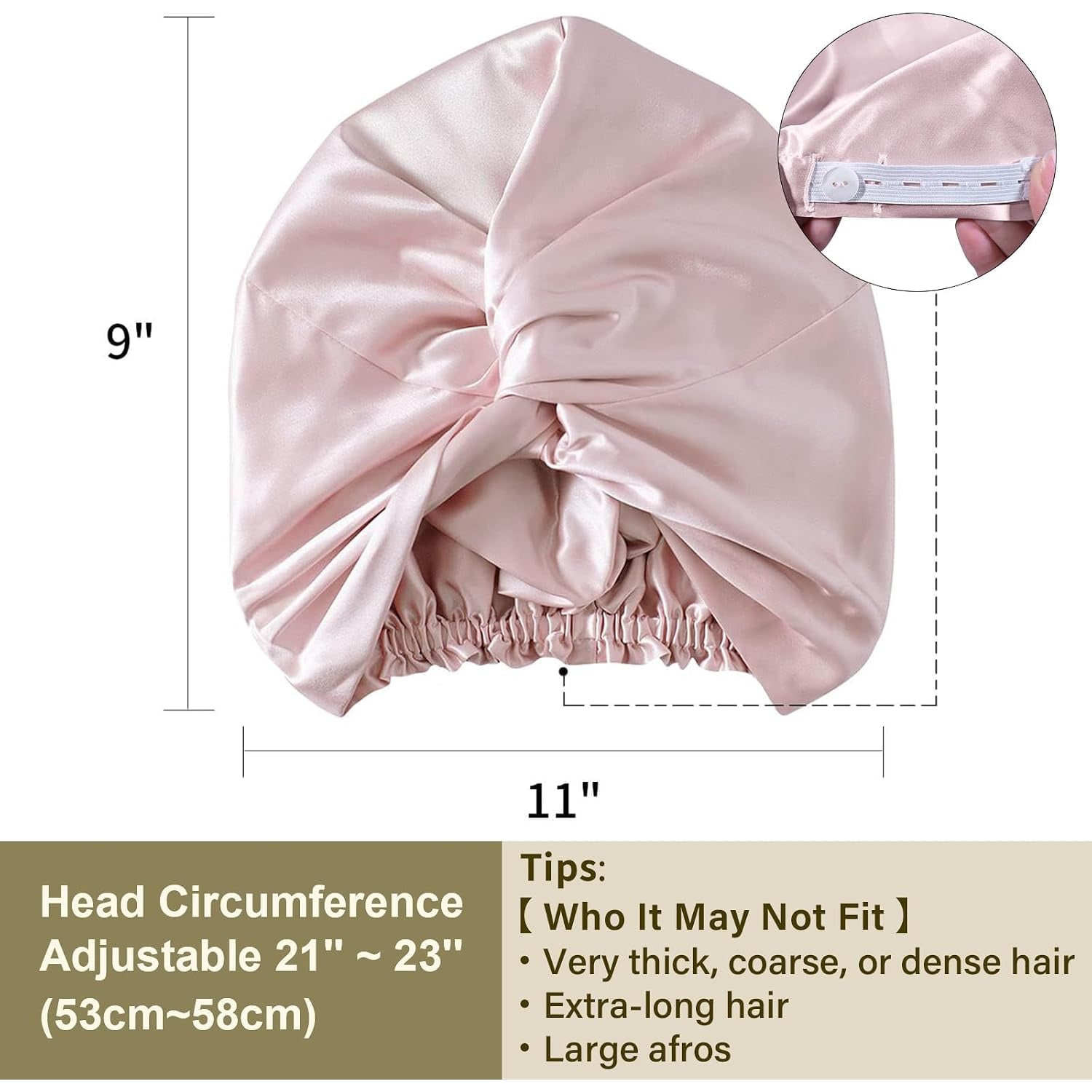
The cap measures about 28 x 23 cm (11 x 9 in) laid flat. That measurement is not the whole story though, because the elastic band at the back is what does the work.
Putting it on properly makes a real difference to whether it stays on. Gather your hair first. Long hair does best coiled into a loose bun or a low pineapple at the crown or the nape, depending on where you want the volume. Then slide the cap on from the front, tuck the hairline in with your fingers, and pull the band down behind your ears so it sits on the bone rather than riding up.
If your cap is coming off at night, nine times out of ten it is because the hairline was not tucked in at the front or the band was sitting too high at the back.
The bow at the front has a practical use here as well. It tells you instantly which way round the cap goes, which you will appreciate at midnight.
Who it suits
If you have curls, coils, braids, twists or any kind of set that you want to preserve overnight, this is squarely aimed at you. The pleated crown protects the shape.
If you have long straight hair that tangles, it works too. Tucking the lengths up stops them being dragged across the pillow all night.
If you have very short hair, a cap is less necessary but some people still like it, particularly if they want the silk against their scalp or they are protecting a fresh cut or colour.
If you sleep extremely restlessly, be realistic. No cap is immune to coming off entirely. The elastic band helps a great deal, but technique matters, and some nights will be better than others.
Looking after it
Silk is less delicate than its reputation suggests, but it does have rules.
Wash it in cool water with a detergent made for silk or delicates. Hand washing is gentlest. If you prefer the machine, put the cap in a mesh laundry bag and run a delicate cycle. Both are fine.
What to avoid: bleach, biological detergents with enzymes, hot water, wringing, and the tumble dryer. Heat is the main enemy. It makes the fibres brittle over time.
To dry, press the water out between your hands or in a towel. Do not twist. Reshape the pleats while the silk is damp, running your fingers along each fold, then dry it flat or hanging somewhere out of direct sun. The pleats come back nicely if you do this.
How often? Weekly is a sensible default. If you use oils, leave-in creams or heavy butters overnight, wash it more often, because product residue will build up on any fabric and silk is no exception.
One cap or two
Worth thinking about. If you wash weekly, you need something to wear on washing night. Two caps in rotation means neither gets worn thin and you always have a clean one ready. It also means one can live permanently in a travel bag.
What to compare when you are shopping
When you put two caps side by side, look at four things. First, whether the silk content covers both sides or just the outer. Second, the momme weight, with anything under 16 likely to feel thin. Third, the closure, since an elastic band is faster than ties but ties are adjustable. Fourth, the shape, matched to your hair length and style.
Price follows the silk. Real mulberry silk at a decent momme weight is not cheap to produce, so a very low price usually means a thinner fabric, a non-silk lining, or both.
The short version
This is a one-size pleated sleep cap in 100% mulberry silk, 22 momme on both the outside and the inside, in a soft light plum pink with a small bow at the front and an elastic band at the back. It measures roughly 28 x 23 cm (11 x 9 in) flat and arrives in a gift box.
It suits curls, braids, twists and longer hair that you want to keep tidy overnight. Hair slides across silk instead of catching on it, which is simply what the fibre does.
Wash it cool, dry it away from heat, reshape the pleats while damp. Do that and it will be doing the same job in a couple of years that it does on the first night.